As World Water Day 2026 draws global attention to the essential role of water in sustaining life, this article continues a series exploring how societies are rethinking their relationship with this increasingly fragile resource. Following earlier pieces on desalination and ice stupas, our attention now turns to two young innovators whose vision and determination have transformed simple ideas into impactful environmental solutions, showing how purpose-driven action can contribute to building a better world.
The Ocean Cleanup
Across continents, responses to marine plastic pollution are emerging, some incremental, others more ambitious. Among them, the Ocean Cleanup has become one of the most closely watched initiatives, combining engineering, environmental science, and large-scale deployment to address this environmental threat at its source and beyond.
This project traces back to Boyan Slat, a 31-year-old Dutch engineer, who already understood the importance of this issue as a teenager. After observing significant concentrations of plastic while diving, he began developing a concept aimed at removing debris directly from the ocean. What started as a student project has since evolved into an international operation, supported by scientific research and ongoing technological refinement.
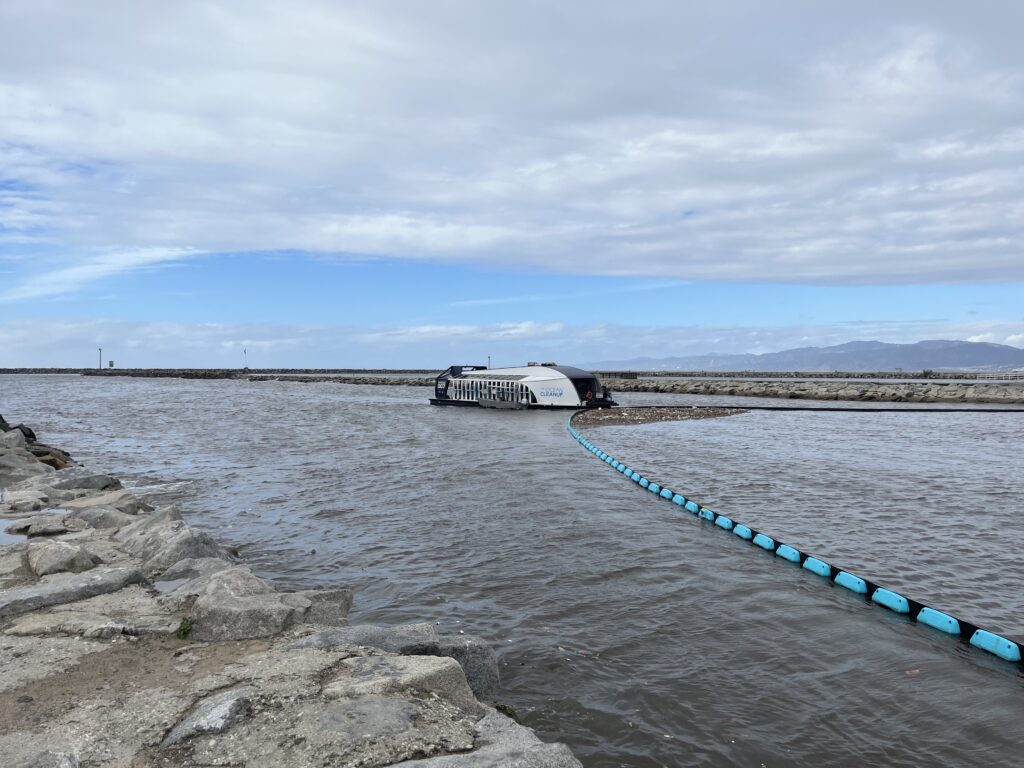
The Ocean Cleanup’s approach is based on relatively simple physics principles. Designed and developed by Boyan Slat, floating barriers are deployed in the open ocean to move passively with currents, gradually concentrating plastic waste for collection. This reduces energy use while limiting disruption to marine ecosystems. Complementing this offshore system are autonomous platforms, called “interceptors”, that capture debris before it can reach the sea. Together, these systems reflect a dual strategy: remediation and prevention.
Recent figures suggest a growing operational scale. To date, more than 45 million kilograms of plastic have been removed from aquatic environments, including over 25 million kilograms in 2025 alone. In parallel, river-based systems are estimated to prevent between 2 and 5 percent of plastic pollution from entering oceans in targeted areas. This project now aims to expand its presence to 30 of the most affected cities by 2030.
While such efforts do not address the root causes of plastic production and consumption, they point to a broader shift: the increasing role of applied science and engineering in mitigating environmental damage already underway. In that sense, The Ocean Cleanup is not a standalone solution, but part of a wider ecosystem of responses emerging worldwide.
The Great Bubble Barrier
In another example, the innovative project The Great Bubble Barrier was born out of a love for the ocean. We were fortunate to be in contact with their team, who provided us with the following details:
Co-founders Anne Marieke Eveleens, Francis Zoet, and Saskia Studer (lifelong sailors and friends) frequently encountered plastic pollution during their sailing trips. Over drinks after one such journey, they began imagining a solution that could stop plastic in rivers without obstructing ship traffic or fish migration. Inspired by the bubbles in their glasses, the concept of a Bubble Barrier took shape. Their idea was soon recognized with an award, and they began testing and refining their first prototypes.
Meanwhile, in Germany, Philip Ehrhorn was exploring a similar idea during his Naval Architecture and Ocean Engineering studies. During a visit to a wastewater treatment plant, he noticed how bubbles used for aeration pushed plastic waste to the surface. He asked himself, “What if we used bubbles to catch plastic in rivers?”
When the four innovators crossed paths, they combined their visions and co-founded The Great Bubble Barrier.
The result of their collaboration is a system that uses a simple yet effective mechanism: a continuous stream of air bubbles generated from the riverbed pushes plastic waste toward the surface and into a collection area, all while allowing fish and boats to pass freely. Originally tested in local waterways, this concept has since expanded internationally, demonstrating how accessible technology can be adapted to different environmental contexts.
Together, these initiatives tell a powerful story of momentum and possibility. From intercepting waste in rivers to removing it from the open ocean, they demonstrate that no single solution stands alone but that, combined, they form a coherent and hopeful response to one of the planet’s most pressing challenges. What unites them is more than technology; it is the conviction of a new generation that change is both necessary and achievable.
By turning ideas into action, and local innovation into global impact, they are not only restoring ecosystems they are redefining what collective responsibility can look like in the years ahead.