
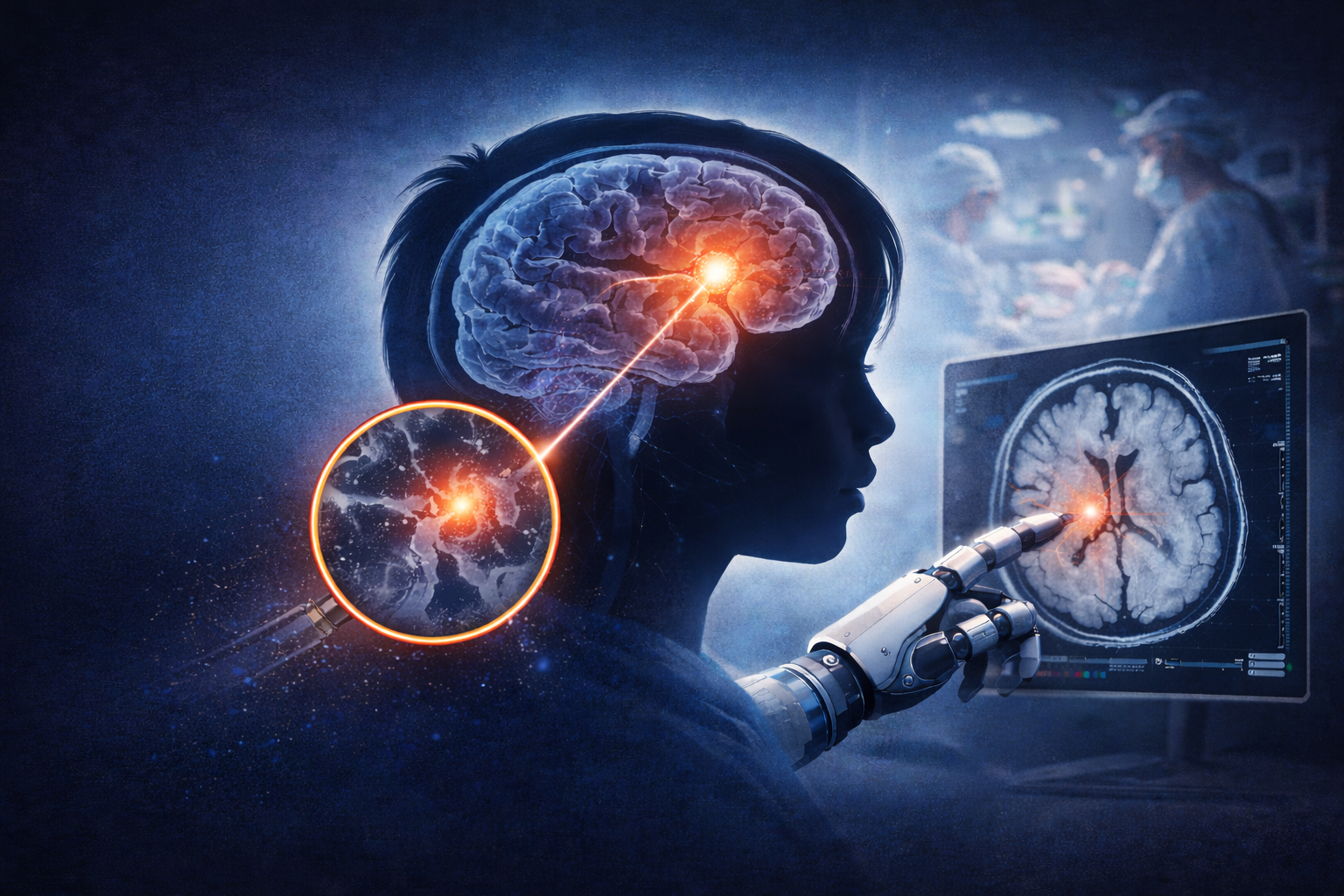
As artificial intelligence (AI) continues to grow and raise questions about its future uses, a new AI tool is giving hope to children living with severe epilepsy. Developed by researchers at the Murdoch Children’s Research Institute (MCRI) and The Royal Children’s Hospital (RCH) in Melbourne, this tool can detect very small brain lesions, called cortical dysplasias, that often cause drug-resistant epilepsy.
These lesions are usually no bigger than a blueberry and can easily be missed in standard MRI scans. Earlier studies showed that up to 80% of such lesions were unnoticed when doctors examined MRI images by hand. Missing these abnormalities delays treatment, putting children at risk of repeated seizures, hospital stays, and learning difficulties.
This is where artificial intelligence comes into play. AI refers to the ability of computers to “learn” from large amounts of data using algorithms (the training phase). The model is then tested on new data to see if it can make accurate predictions (the testing phase). In the case of epilepsy, the AI detector, sometimes called the “epilepsy detective”, was trained on both MRI and PET scans in order to recognize even the smallest brain lesions.
According to a recent study published in the scientific journal Epilepsia, the AI tool was able to reach an accuracy of up to 94%. Out of 17 tested children, 12 underwent surgery and 11 are now seizure-free. Dr. Emma Macdonald-Laurs, the neurologist who led the study, explained that the detector does not replace doctors but acts as a helpful assistant. “It is like a detective that helps us put the puzzle pieces together quicker so we can offer life-changing surgery earlier”, she said. With more precise interpretation of imaging, surgeons can plan safer operations, avoiding critical brain areas that control speech, movement, and memory.
The first results are remarkable. Royal, a five-year-old boy, suffered up to 19 seizures within two hours before doctors used the AI tool to identify his lesion. After surgery, Royal has been seizure-free. His mother said the technology likely saved his life and helped him get his personality and energy back. Another child, John, began having seizures at age eight. After doctors used the AI tool, he too underwent surgery and has not had a seizure since.
Epilepsy affects some 50 million people globally, according to a February 2024 WHO report. Among children, cortical dysplasias are one of the most common causes. Seizures usually start in early childhood and become more frequent over time. For many families, medication is not enough, and surgery is the only way to keep the epilepsy under control – if the abnormal brain tissue can be found.
The next step for the Australian team is to test the detector in more children’s hospitals across the country and learn how families and doctors feel about using AI in epilepsy diagnosis. For children like Royal and John, the tool has already proven to be life-changing.
More broadly, this example perfectly illustrates the potential of AI to reduce the risk of clinical errors and help improve care on a larger scale. Beyond epilepsy and imaging, AI continues to demonstrate its benefits in medicine, notably in the prediction of surgical complications from clinical data, the monitoring of patient safety in real time, and the detection of pressure ulcers, to name but a few.
SOURCE
https://www.mcri.edu.au/news/news-stories/ai-tool-detects-tiny-brain-lesions-children-with-epilepsy
https://www.abc.net.au/news/2025-10-01/ai-tool-detects-epilepsy-lesion-seizure-free-brain-surgery/105833450
https://www.news-medical.net/news/20250930/AI-tool-detects-tiny-brain-lesions-to-improve-epilepsy-treatment-in-children.aspx
https://www.rfi.fr/en/international-news/20250930-ai-tool-helps-researchers-treat-child-epilepsy
https://www.nature.com/articles/s41746-022-00731-5
Link to publication: https://onlinelibrary.wiley.com/doi/10.1111/epi.18628