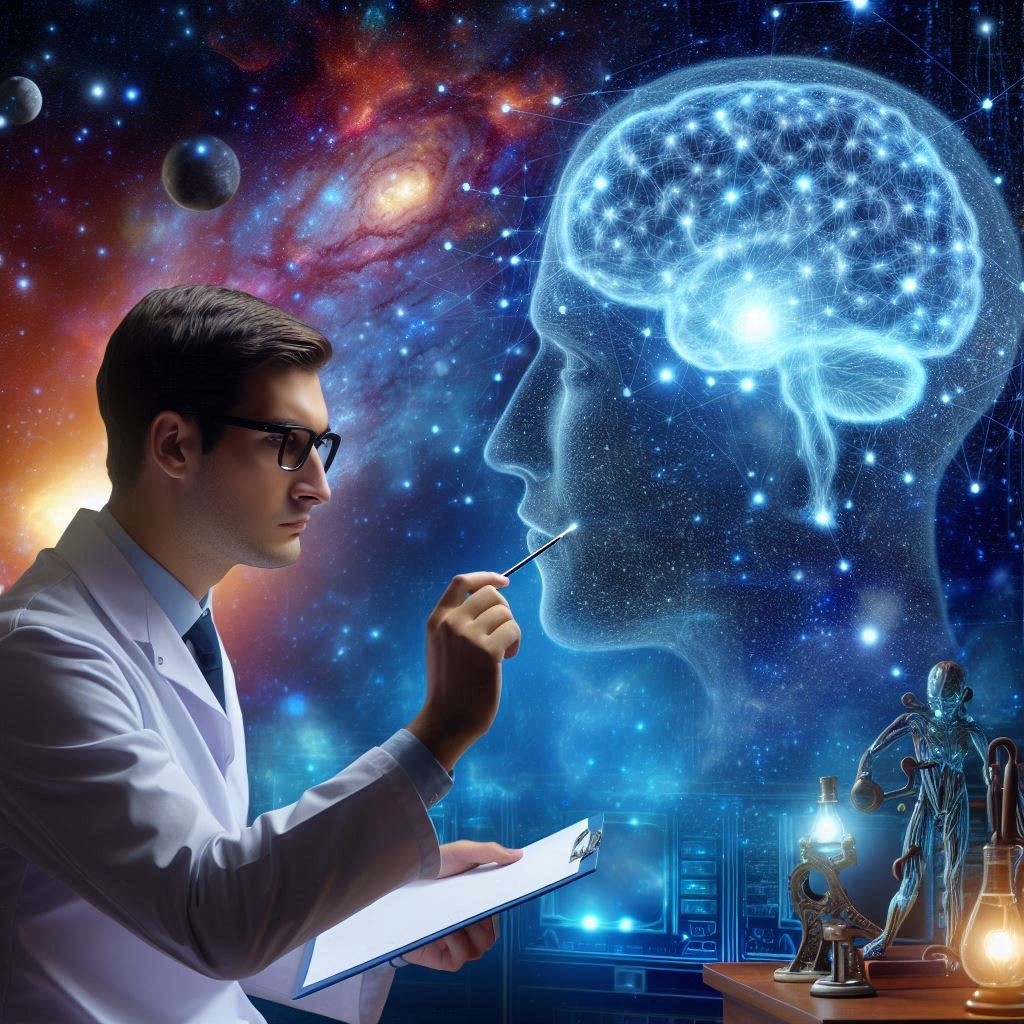

“Consciousness science is no longer a purely philosophical pursuit. It has real implications for every facet of society—and for understanding what it means to be human.” Professor Axel Cleeremans
Since the beginning of modern science, consciousness has often been treated as a philosophical topic, largely avoided by leading research. However, recently, this trend has begun to reverse. Once subjective or even mystical, consciousness is now recognized as a serious scientific question, attracting the attention of major institutes and top scientific journals. Some researchers also emphasize the urgency of explaining consciousness as artificial intelligence (AI) continues to grow at a rapid pace. “Understanding consciousness is one of the most substantial challenges of 21st-century science” says Professor Axel Cleeremans [1] from the Université Libre de Bruxelles. He adds: “Consciousness science is no longer a purely philosophical pursuit. It has real implications for every facet of society—and for understanding what it means to be human.”
Explaining consciousness is particularly challenging as the notion itself is hard to define without referring to what it feels like to be conscious – what philosophers call an ostensive definition. Alternatively, one could think about consciousness as the brain’s ability to process information from external stimuli or report mental states. Philosopher David Chalmers classifies these aspects as the easy problems of consciousness [2], as they are mostly related to neuroscience. This contrasts with the hard problem of consciousness, which, according to Chalmers, means explaining inner experience and its subjective nature.
From the scientific point of view, all these questions have started to captivate even the most prominent institutions. This is the case of the Massachusetts Institute of Technology (MIT) which has recently launched a Consciousness Club, led by philosopher Matthias Michel and neuroscientist Earl Miller. The club puts together researchers from neuroscience, philosophy, and cognitive science to study key questions including how consciousness arises in the brain, unconscious perception, and consciousness in animals or AI. “You can’t study the complexities of executive [brain] function and not get to consciousness”, Miller says, showing how important the study of consciousness has become [3]. Recently, the club started to use transcranial focused ultrasound, a noninvasive method that can stimulate deep brain structures. “It’s a tool that could help address the hard problem of consciousness, probing the neural circuits that generate sensations, perceptions, or even complex thought” says MIT researcher Daniel Freeman [4].
Finally, prestigious scientific journals are also giving consciousness more attention, with many articles and dedicated sections. Science, a journal with a well-established reputation, recently reviewed A World Appears, the latest book by Michael Pollan, which investigates the elusive nature of consciousness [5]. While qualifying some of Pollan’s ideas as eccentric, the review highlights the “charming, witty, and insightful” tone of the book, mentioning its exploration of fascinating questions such as the fragmented nature of consciousness or the reality of the self [6].
Taken together, all these examples reveal a clear shift in how consciousness is viewed in today’s science. Long marginalized, this question is now largely discussed within and between institutions. While disagreements remain about its nature and explanation, consciousness has become a legitimate scientific problem, one that many researchers consider unavoidable.
[1]https://erc.europa.eu/news-events/news/scientists-urgent-quest-explain-consciousness-ai-gathers-pace
[2] https://personal.lse.ac.uk/ROBERT49/teaching/ph103/pdf/chalmers1995.pdf
[3] https://news.mit.edu/2025/science-of-consciousness-1118
[4] https://news.mit.edu/2026/new-tool-could-tell-us-how-consciousness-works-0112
[5] https://michaelpollan.substack.com/p/announcing-my-new-book-a-world-appears
[6] https://www.science.org/doi/10.1126/science.aec8147