

“Food grows where water flows. And with this water comes peace, prosperity, and hope” Sujan Sarkar
In early 2026, off the coast of Mongstad, Norway, engineers are preparing to commission Flocean One – the world’s first underwater desalination plant. No industrial buildings on the coastline, no noise pollution. Just a submerged capsule, silently transforming the ocean’s natural pressure into drinking water. Flocean has been selected as a winner of the World Economic Forum’s (WEF) prestigious Water Resilience Challenge.
This breakthrough is not an isolated innovation. Rather, in the face of the increasing scarcity of fresh water, it is part of humanity’s long history of ingenuity in overcoming one of this century’s greatest challenges.
From the Sahel to the Middle East and from California to Central Asia, tensions over access to water are increasing. Climate change is intensifying droughts and causing groundwater tables – which take centuries to replenish but disappear in a matter of decades – to run dry. Meanwhile, changing rainfall patterns are threatening the foundations of entire societies.
According to UN projections, nearly 6 billion people could be living in areas of severe water stress by 2050. The UN also warns that by 2030, global demand for fresh water could exceed available resources by about 40% – a gap that no single solution can fill.
Faced with this situation, solutions do exist. And they are already at work.
Turning Ocean Water into Drinking Water
The process of removing salt from seawater to make it drinkable is well known. Until recently, however, it was an expensive and polluting process that required a lot of labour. The good news is that it is now possible to desalinate on a large scale at an acceptable cost and using increasingly low-carbon energy sources.
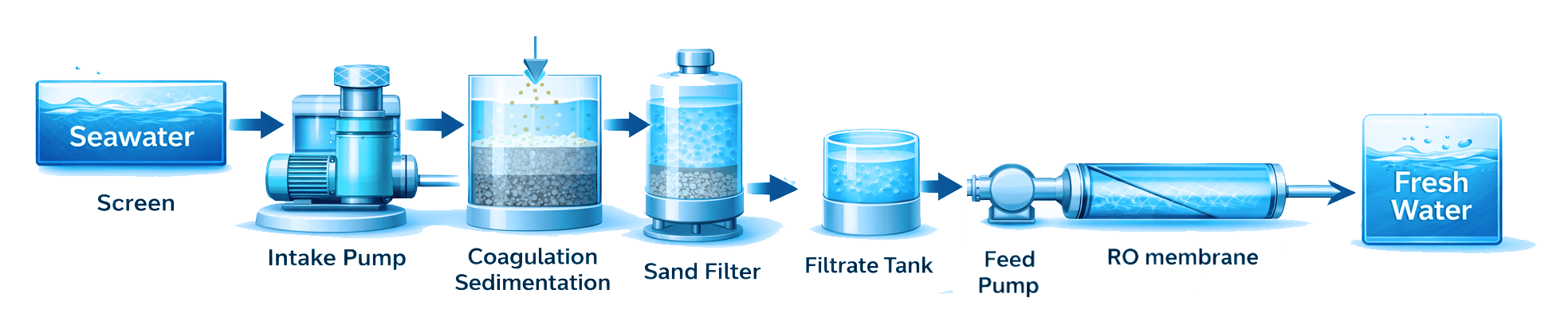
The most common method is reverse osmosis, in which seawater is forced through membranes under high pressure. These membranes are so fine that only water molecules can pass through, leaving salt and impurities behind. This technology dates back to the 1960s and has been considerably improved since then. Since the 1970s, the energy required for desalination has decreased by around 85%. Today, more than 300 million people worldwide rely on desalinated water for their daily needs.
The cost gap with conventional sources of freshwater is therefore narrowing. As renewable energies make desalination cleaner, the case for its development becomes stronger with each new drought.
Few cities illustrate this change as clearly as Perth, in Western Australia.
Since the 1970s, the city has experienced a decline in rainfall of almost 20%, which has directly threatened the water supply of its two million inhabitants. Rather than waiting for the situation to deteriorate, Perth invested in two large desalination plants, which now provide 30 to 40 per cent of the city’s drinking water, according to the Western Australia Water Corporation. The first plant, located in Kwinana, produces 45 billion litres of water per year and operates using only renewable wind energy.
Perth also recycles its wastewater and has run long-term public campaigns to reduce consumption. The result is a city that has transformed a climate threat into a model of collective ingenuity — an example that many other cities around the world are now following.
Flocean: desalination at 600 meters underwater
What Perth has achieved on land, Flocean is reimagining beneath the waves.
The principle behind Flocean’s technology is remarkably elegant. At depths of 300 to 600 metres, the natural pressure of the ocean – around 50 times the pressure at sea level – is sufficient to drive reverse osmosis. This eliminates the need for large, energy-intensive industrial pumps, as the ocean does the work itself.
Below 300 metres, sunlight disappears, meaning photosynthesis stops and the main causes of membrane clogging in conventional plants, algae and bacteria, are significantly less prevalent. According to the company’s data, pre-treatment infrastructure requirements are reduced by 60%, since the membranes have a longer lifespan and maintenance costs are lower. The brine – the concentrated saltwater produced by desalination – is also discharged deep underwater, far from fragile coastal ecosystems and without the addition of chemicals. According to Flocean, using natural pressure reduces energy consumption by 30–50% compared to conventional land-based plants.
Flocean One, the first commercial facility, will begin operating near Mongstad in 2026 with an initial production capacity of 1,000 m³ of fresh water per day. Each capsule is designed to produce 7,500 m³ of fresh water per day and can be deployed in groups to supply a medium-sized city. The company operates under a Build-Own-Operate model, financing, building and operating the facilities before selling the water as a service, meaning that municipalities do not have to invest in heavy infrastructure.
In October 2025, TIME magazine ranked Flocean as one of the best inventions of 2025 – the only desalination solution on the list. At the end of the year, American water giant Xylem invested in the company to accelerate its global deployment. Projects are already underway in the Mediterranean, the Red Sea, the Indian Ocean and the Pacific Islands.
What the future holds
The next chapters are already being written. In October 2024, MIT designed a solar desalination system that does not require batteries and synchronises its rhythm with natural variations in sunlight. Meanwhile, in August 2024, the state of California officially approved regulations on direct potable reuse (DPR) allowing recycled water to be injected directly into drinking water systems for the firs time. Israel now reuses 90% of its wastewater for agriculture. Meanwhile, Singapore covers 40% of its water needs through its NEWater programme.
France is also beginning its transition. Argelès-sur-Mer is launching the largest project to reuse wastewater for farmers, and the Cagnes-sur-Mer racecourse is set to become the first in France to irrigate its lawns with treated wastewater. These local initiatives demonstrate an increasing awareness that water reuse is not just an option, but a necessity that is gradually being adopted across the board.
Artificial intelligence is also increasingly being deployed to help cities detect invisible leaks in ageing infrastructure, thereby preventing millions of gallons of water loss. In the US alone, nearly two trillion gallons of treated water are lost each year, representing a financial loss of around $8 billion. According to EIN magazine, AI is beginning to reduce this loss through predictive detection.
World Water Day, which we celebrated today, reminds us that protecting rivers, restoring ecosystems and reducing consumption are all essential if we are to ensure a future on our planet. At the same time, the inspiring examples above, demonstrate that alongside preservation, innovation is creating opportunities that did not exist a generation ago. Therefore, the water crisis is also a hopeful story of a civilization finally beginning to understand the true value of what it has long taken for granted and seeking new ways to undo decades of overexploitation and harm.