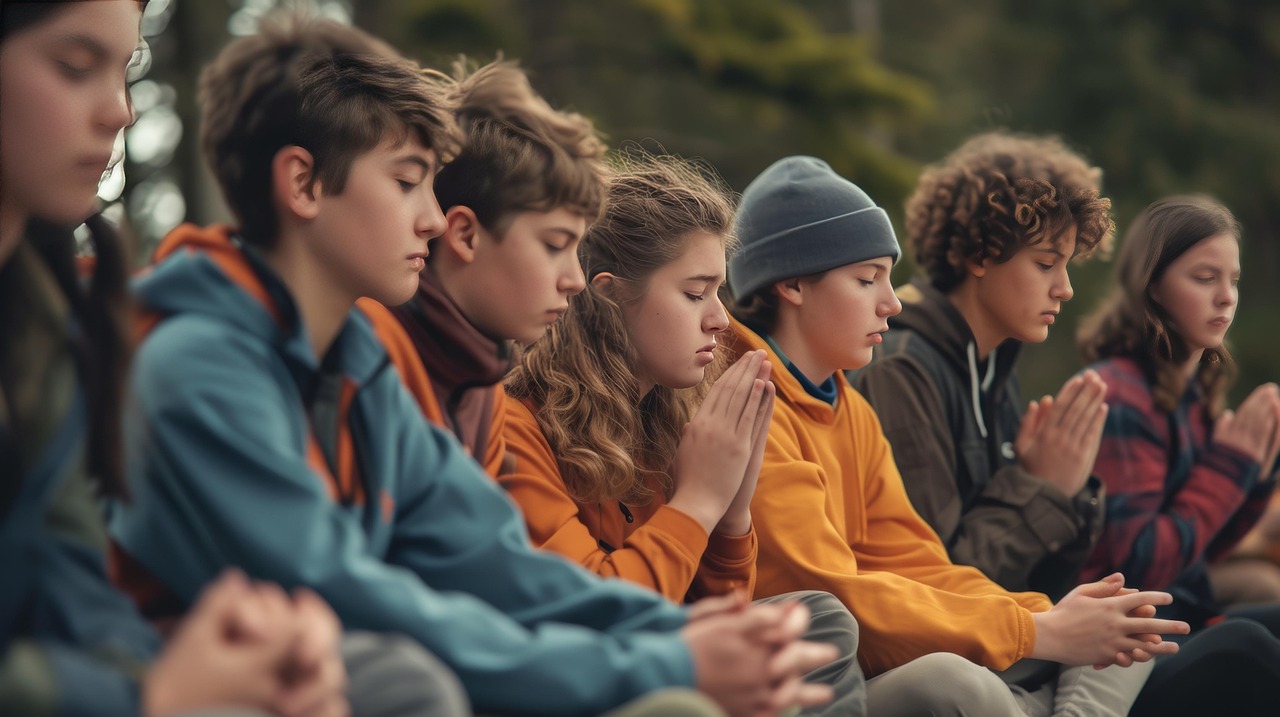
This Sunday is Easter, when most Christians around the world celebrate the resurrection of Jesus Christ. This week also, the Catholic Church in France has announced that it will baptise an all-time record 21,400 teenagers and adults into the Catholic faith, which is a significant increase on last year’s already record-breaking total of 18,000 adult and teenage baptisms. Nearly half of this record number (42%) are aged 18 to 25, while a further 40% are aged 25 to 40.
The obituary for faith has been written many times. Yet the picture emerging among under-35s in particular, looks less like a funeral and more like a ‘quiet’ spiritual and religious revival, as one British report has termed it. On the one hand, there is a growing number of ‘spiritual but not religious’ young people who prefer to hold beliefs and find meaning outside of religious institutions. On the other hand, there is a trend of explicit religious belonging, with young people showing a particular attraction to the most liturgical, ritualistic or charismatic forms of Christianity, such as the Latin mass, Orthodoxy, or the Pentecostal church. Both phenomena are evident in the data and both skew young.
Let us begin with the ‘spiritual but not religious’ group. Last September, the renowned US-based Pew Research Center published a report that challenged the familiar narrative of global religious decline. Of the more than 34,000 respondents from 22 participating countries, many who selected ‘none’ in response to the question about religion nonetheless hold recognisably spiritual beliefs. In the United States, for example, nearly half (45%) of those who identify as ‘nones’ say they believe in God, as do at least one in four in most other countries.
Pew’s cross-national study also reveals that sizeable minorities of unaffiliated individuals affirm not only the existence of God, but life after death, belief in energy, and other spiritual beliefs; they are by no means uniformly secular in their outlook, as the narrative sometimes goes. In other words, the non-religious segment of the world’s population is not a homogeneous group of disenchanted rationalists, but rather a diverse group that includes many people who remain spiritually open. Conversely, atheists – that is to say, those who affirm there is no God or higher power – represent less than a third of all non-religious people in most countries studied by Pew. Previous research by the think tank Theos in Britain came to a similar conclusion, identifying three main types of nones: ‘campaigning’, ‘tolerant’ and ‘spiritual’. Of these; only around half – the ‘campaigning’ non-religious who oppose all forms of religion and spirituality – said that they did not believe in God at all.
This trend particularly affects young people: in most of the countries analysed, adults aged 18-35 are much more likely than older adults to identify as ‘nones’. They are also more likely than older generations to affirm spiritual convictions while not being religiously affiliated. This spiritual curiosity is also not necessarily inimical to organised religion. Research pursued by The British and Foreign Bible Society found that non-religious young adults were much more open to invitations to attend church services, read or discuss scripture, and engage in conversations about Christianity than older generations of nones.
As seen above, in some cases, this spiritual openness translates to religious conversion. Besides the record number of baptisms, France – one of the countries with the highest proportion of atheists in its non-religious population – has also seen last year a record 13,500 pupils from the Paris region attending the youth pilgrimage to Lourdes. In May 2025, organisers estimated that 40,000-50,000 people processed through central Paris for the “Marche pour Jésus”, which was part of a multi-city mobilisation. It would be wrong to speak of a wholesale revival of Catholicism in France. Yet, together, the data suggests a real youthful religious energy that sits awkwardly with the ‘religion is over’ thesis.
Meanwhile, across the Atlantic, another Pew report, the Religious Landscape Study, reveals that the long-term decline of Christianity in the US has slowed and may have levelled off. While not an increase in participation among young people per se, this phenomenon sits alongside a flurry of commentary about stabilising or modestly rising participation among younger segments of the population. Although headlines about a ‘religious resurgence’ among Gen Z (those born between 1997 and 2012, who are now teenagers or in their twenties) are probably exaggerated, particularly with regard to men, they are not entirely unfounded.
So what, exactly, is going on? Two observations feel safe.
Firstly, although fewer young adults in the Global North wish to identify with a particular religion, many of them remain spiritually curious. A significant proportion of people without a religious affiliation believe in God or a higher power and an afterlife. Although they largely reject formal religious institutions, the vast majority are not atheists and appear to be spiritually curious. This is most evident in US data, but similar trends can be seen across Western Europe and Australia.
Secondly, events such as mass youth pilgrimages and city-centre marches demonstrate that visible, communal faith retains an appeal for some young people. There is some preliminary evidence suggesting that an increasing number of young adults are turning to organised religion in ways that their parents did not. However, the findings are not conclusive, not least because Generation Z is still young. Nevertheless, these trends could transform the religious landscape in the future, so we should be keeping an eye on them.
All of this paints a more interesting picture than the ‘religion is dying’ narrative suggests. Among under-35s, those who are ‘spiritual but not religious’ and those who are explicitly religious are neighbours on parallel journeys rather than rival armies. Together, they are toppling modern man’s ideology of secularisation and the myth of technological and scientific progress as our reason to be.
Despite being born into an increasingly godless world where the spiritual and numinous are marginalised and ridiculed, young people the world over long for meaning in the same way as every culture since the dawn of humanity – notwithstanding efforts by their parents and grandparents to secularise them – and it is in this longing for meaning and purpose that they seek, and find, God.