Our first article in this mini-series explored Gelephu Mindfulness City’s (GMC) physical and ecological design. This second part delves into the forces shaping its governance, culture, and global impact, and how spirituality forms the very backbone of this city in motion.
A Strategic Sandbox
GMC has been established as a Special Administrative Region (SAR) by Royal Charter in December 2024. The SAR grants GMC legislative, executive, and judicial autonomy. It can formulate its own policies, legal frameworks, and regulatory systems designed to attract investment and innovation, without risking the stability of the whole nation.
Under the “Diamond Strategy”, the plan is to let Gelephu chart its own course for the first two decades, under the “One country, two systems” framework, while Bhutan continues along its former development path. By 2045, the city and the country will begin to compare notes on lessons learned and innovations tested, with the aim of gradually merging into “One country, One system”, by 2065.
The King has framed this ability to innovate decisively without losing coherence as an opportunity unique to smaller nations. Gelephu is therefore best understood not as a break from Bhutan’s past, but as an extension of its adaptive pragmatism.
“Where larger populations would struggle with disunity and disagreements, we have the strength of harmony and shared purpose. Our unity will allow us to move mountains,” noted King Jigme Khesar Namgyel Wangchuck.
Crucially, the country is preparing its youth to manage the city’s future. Through shadowing programs with global experts, young Bhutanese are being trained to eventually lead the SAR independently. In doing so, it is demonstrating openness to outside expertise, while making sure not to create long-term dependence. On the 116th National Day Address, the King announced: “There are economic hubs elsewhere that invite foreign investment by providing a conducive business environment and compelling incentives. Bhutan’s economic hub will offer all that and more. It will be one-of-a-kind, anchored on the vision and values of GNH (Gross National Happiness).”
Spirituality as Foundation
In GMC, spirituality forms the foundation of the city’s vision. Beyond governance and architecture, the city’s orientation is guided by Buddhist values and national identity. Through a Buddhist lens, the King articulated a threefold aspiration:
a strong economy in the outer realm, prosperity for people in the inner realm, and a firm spiritual foundation in the secret realm. These three realms refer respectively to the material, social and spiritual dimensions of life, in Vajrayana Buddhist philosophy.
This layered vision offers a different way of thinking about development. In most urban models, economics structures, logistics organizes, and technology optimizes. Here, consciousness is asked to guide development, making spirituality an invisible infrastructure that informs priorities, shapes space, and influences decision-making.
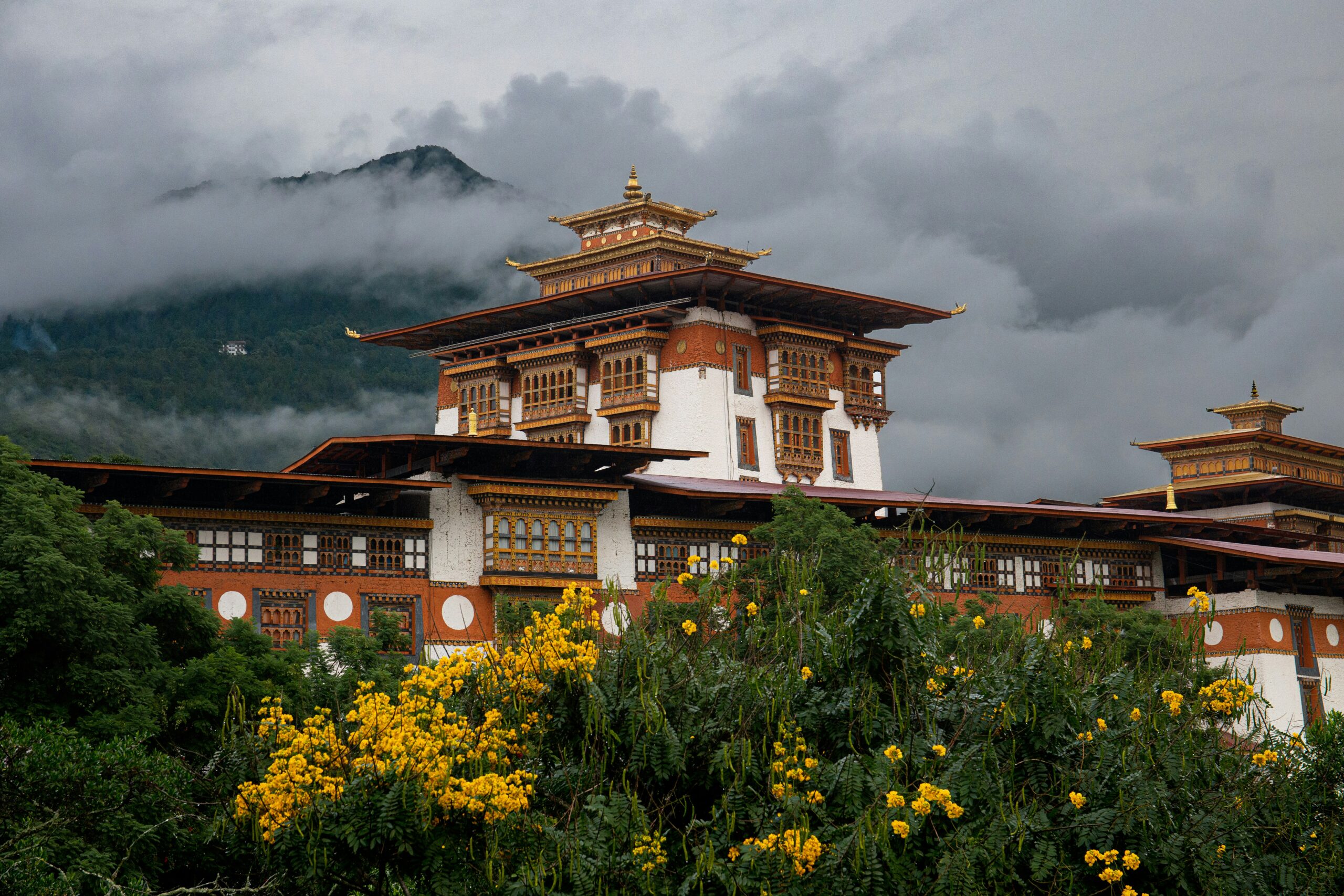
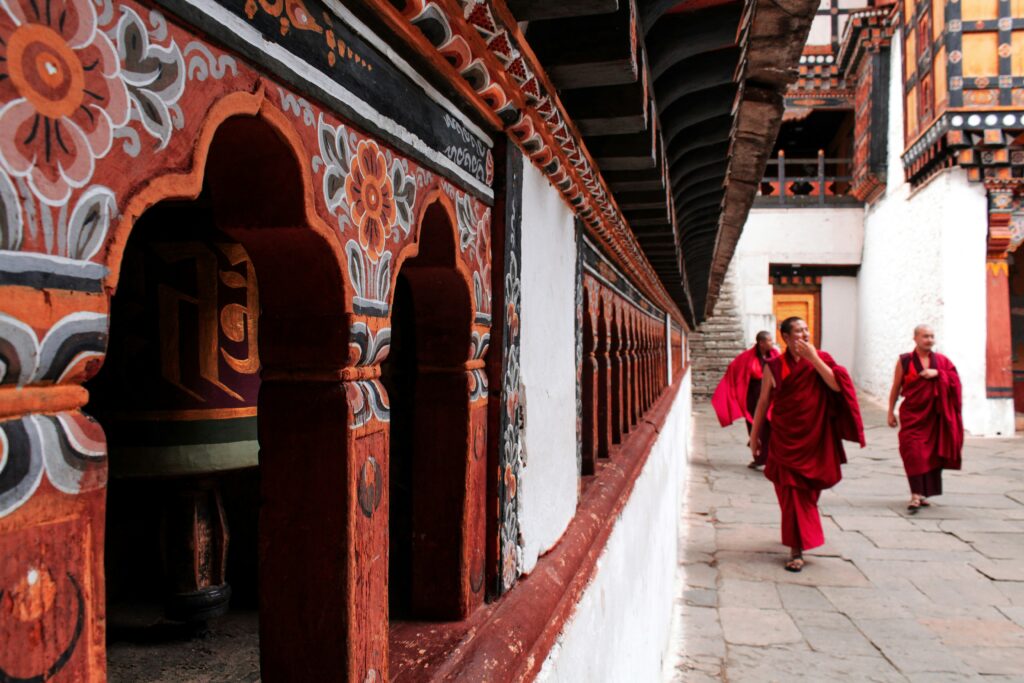
In announcing Gelephu Mindfulness City, King Wangchuck made clear that economic ambition alone would not be enough. Drawing on Bhutan’s identity as a Buddhist nation, he invited the monastic community – the Dratshang, Lams, and Tulkus – to help establish the city’s spiritual identity through monasteries, temples, and spiritual centers. More than twenty projects have already been validated, forming what the King described as a “strong spiritual foundation” for the city. The intention is to cultivate in GMC a comparable sense of rootedness, where sacred architecture, daily life, and civic institutions coexist.
A powerful milestone came on February 21, 2026, with the groundbreaking of the Chorten of Gelephu, a sacred structure designed to connect Bhutan’s Buddhist history with the city’s emerging future. As described by project leaders, it “stands as a symbol of aspiration, compassion, and spiritual continuity”. This follows the earlier groundbreaking of the airport, signaling that GMC is a city whose spiritual and civic infrastructure is already taking shape.
Global Significance
King Wangchuck insisted Bhutan is not seeking to replicate what has been done elsewhere. Instead, he is offering to let Bhutanese national identity, which he called their “greatest strength”, shape all aspects of this development project. “GMC, he said, will stand as a city grounded in [our] values, where purpose matters as much as profit or productivity.”
In that sense, Gelephu functions as a real-time case study for the 21st century:
- Can a nation open itself to the world while maintaining sovereignty and cultural integrity?
- Can economic competitiveness coexist with environmental stewardship?
- Can consciousness become a guiding framework for governance and development?
These questions sit at the heart of global debates for our present and our future.
Unlike purely theoretical urban models, Gelephu will evolve in the open. Its governance structures, economic outcomes, architectural execution, and social impact will be observable over time. It is a measurable experiment in conscious modernization, where challenges are real, but the vision is clear.
Gelephu Mindfulness City does not simply expand Bhutan’s urban footprint; it redefines what urban expansion can mean. In a world where development is often reactive, responding to crises of climate, identity, or inequality, GMC attempts to build coherence from the beginning. Governance, economy, culture, spirituality, and infrastructure are conceived as one integrated and aligned system.
GMC tests whether a city can be consciously designed, from legal frameworks to sacred spaces, as a living, coherent whole. In practical terms, this means rethinking how cities are planned: not only around efficiency and economic growth, but around meaning, balance and long-term harmony between their different components. In this sense, a conscious city is one where urban planning, environmental stewardship, cultural identity, and spiritual life are understood as deeply interconnected, each influencing the others, and where urban space is designed in alignment with that awareness. That could be its greatest contribution, not just to Bhutan, but to the global conversation on the future of cities. If it succeeds, Gelephu will not simply be a new economic hub; it could become a model for building conscious and coherent cities in the 21st century.
It is a very bold project indeed, but the Bhutanese are not afraid of the adventure. As King Jigme Khesar Namgyel Wangchuck affirmed: “When we set a path for ourselves, it is good to have legitimate concerns. But we must not hesitate. It is in our own hands to determine our success. Will we succeed? Yes, we will succeed.”



One thought on “Bhutan Gelephu City Series 2/2 – Spirituality, Governance, and Global Ambition”
Comments are closed.