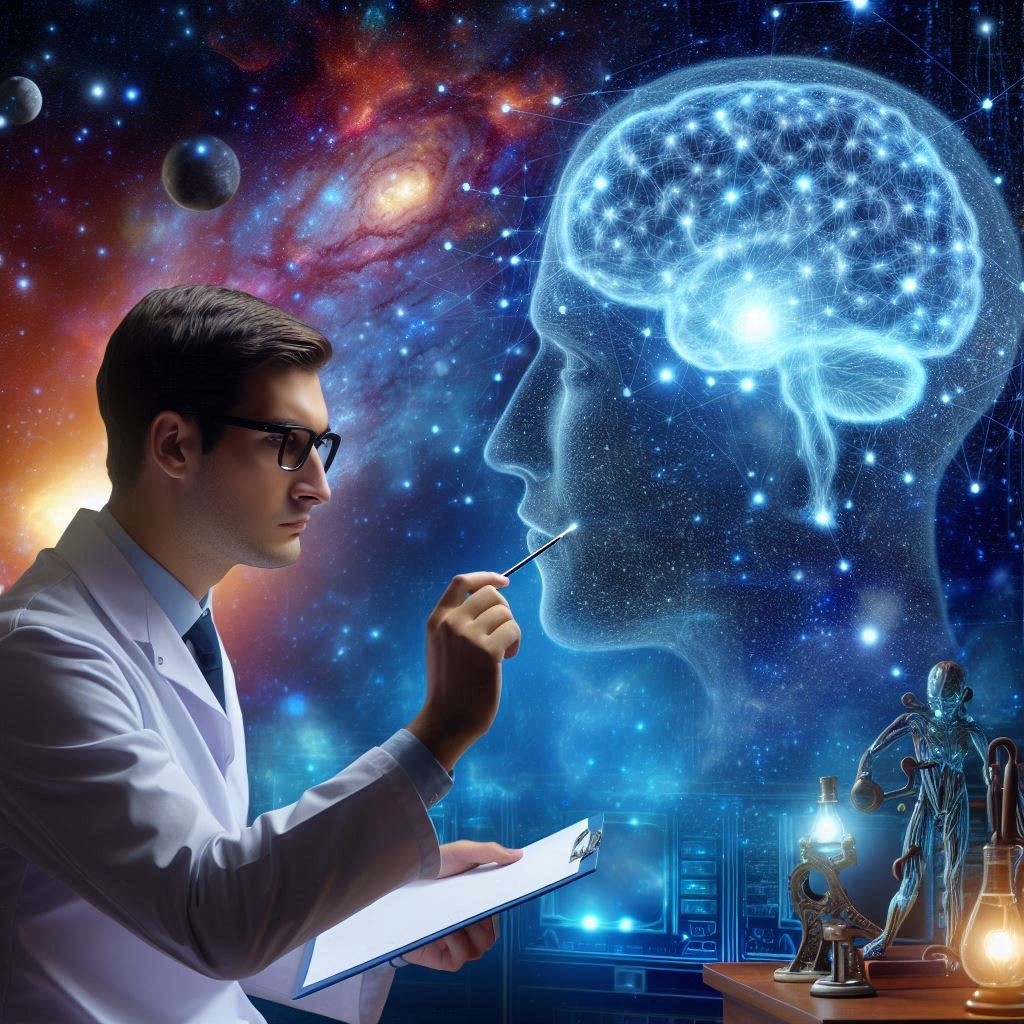
On Sunday, March 29th, the Paris-based Université Interdisciplinaire de Paris (UIP)—which focuses on analyzing modern scientific paradigms—hosted a conference titled “Consciousness and the Invisible. When Science Meets with the Unexplained [La Conscience et l’invisible. Quand la science rencontre l’inexpliqué]”. Bringing together speakers from fields as varied as physics, neurosurgery, neuroscience, philosophy, ethnobotany and medicine, this conference touched on quantum physics, consciousness beyond the brain, the non-locality of consciousness, Near-Death-Experiences, the Sun and animals, among other themes. Whereas these themes have long been excluded from Modern Science, we are witnessing a shift in Science, and consciousness is at the very center of what some call a scientific revolution…We have already mentioned in a previous article that consciousness has become a legitimate scientific problem. But what exactly can science tell us about non-material phenomena like Consciousness or the Invisible? And what does this event tell us about the recent changes in Science and the study of Consciousness?
Modern Science as a Materialist Way of Seeing the World
Modern science built itself by excluding from its scope of inquiry the invisible; more broadly, it has excluded anything non-material as a starting point for scientific inquiry. Rooted in the movement of emancipation from religion, the exclusion of the invisible progressively led to the basis of the materialistic science in the 19th century, which postulates that all reality is material or physical, matter is unconscious, and evolution is purposeless. Darwin’s theory of evolution, in a context where naturalists previously defended the idea of unchanging species created by God, is a good example of this process. From a materialist viewpoint, exploring invisible phenomena has historically generated—and continues to generate—suspicion among scientists.
Even though Consciousness, as a non-physical phenomenon, has suffered the same destiny, it is still being studied because it is such a central feature of the human experience. When all is said and done, our conscious experience of being is the ultimate, undeniable truth.”
Science couldn’t negate it, so neuroscience studied it by trying to explain it within the materialistic worldview as a hypothetical byproduct of brain activity, but it has never been able to really explain the origin of consciousness. This is the well-known phenomenon of the ‘hard problem of Consciousness’, coined by David Chalmers in 1995: after decades of studies, nothing has really proven that consciousness is a byproduct of brain activity, just a correlation and a form of relationship.
In his book The Science Delusion. Freeing the Spirit of Enquiry, biologist Rupert Sheldrake explains how this materialism came to be and how 19th-century assumptions became dogmas no longer recognized by most scientists. He set out 10 dogmas explaining how and why any non-material phenomena are not regarded as legitimate objects of scientific study. Sheldrake’s central point is that these dogmas are no longer acknowledged as 19th-century assumptions, but are often taken for granted as part of a wider inherited worldview. In his view, Science has thereby lost sight of its original purpose of inquiry into reality, by excluding phenomena from its domain of investigation.
Towards a Post-materialist Science
The conference Consciousness and the Invisible is not an isolated event. It takes place within a deeper, broader movement of researchers, scientific journals, studies, and conferences promoting the scientific study of consciousness and other non-material phenomena.
In 2014, in Tucson, scientists gathered for a summit on post-materialist science, spirituality and society, from which emerged an 18-point Manifesto for a Post-Materialist Science. Its main intent is to denounce materialism as dogma in science and reaffirm that scientific enquiry should not proscribe or exclude any phenomena but observe, experiment and look for a theoretical explanation of everything.
More importantly, this is not a claim from a few isolated scientists. The Manifesto has now been signed by more than 621scientists, professors, doctors, and thought leaders coming from 230 universities across 60 countries, including Princeton, Harvard, Columbia University, just to mention a few. The message of the post-materialist scientists is not just about denouncing the limits of the materialist approach in science; it also provides the basis of a new paradigm called post-materialism. Drawing on the research and publications of the scientists involved in the summit (studying near-death experiences, influence of the consciousness on the physical world in a non-local way, interconnectedness of consciousness at a global level, even reincarnation, etc.), the Manifesto advances ideas such as the one that “minds cannot be reduced to matter”. This work confronts the premise of materialism, asserting that consciousness is non-physical and that other, immaterial levels of reality exist.
What is fascinating is that this new movement is not limited to the hard sciences, such as physics, biology, chemistry, astronomy, and geology. The science of consciousness is also slowly developing in the so-called soft sciences, like the social sciences and humanities. For instance, we can point to the inclusion of quantum physics theories and reflections on consciousness in disciplines like anthropology, with Trnka and Lorencová’s work on Quantum Anthropology (2016); philosophy, in P Goff’s Galileo’s Error. Foundations for a new science of Consciousness (2019); or in sociology, with A Wendt’s Quantum Mind and Social Science. Unifying Physical and Social Ontology (2015). On June 16-17, Consciousness will be the theme of a conference in the field of Education at York St John University in England. Consciousness and the Invisible can be seen as part of a deeper shift from the materialist to the post-materialist paradigm, considered by some as a true scientific revolution.
For its advocates, this amounts to a shift comparable in significance to the Copernican revolution, when we transitioned from geocentrism to heliocentrism. It opened up a completely different and new relation to the world: a conscious world and alive as it has been described for millennia by some traditions.


One thought on “Reconciling Science and Consciousness”
Comments are closed.