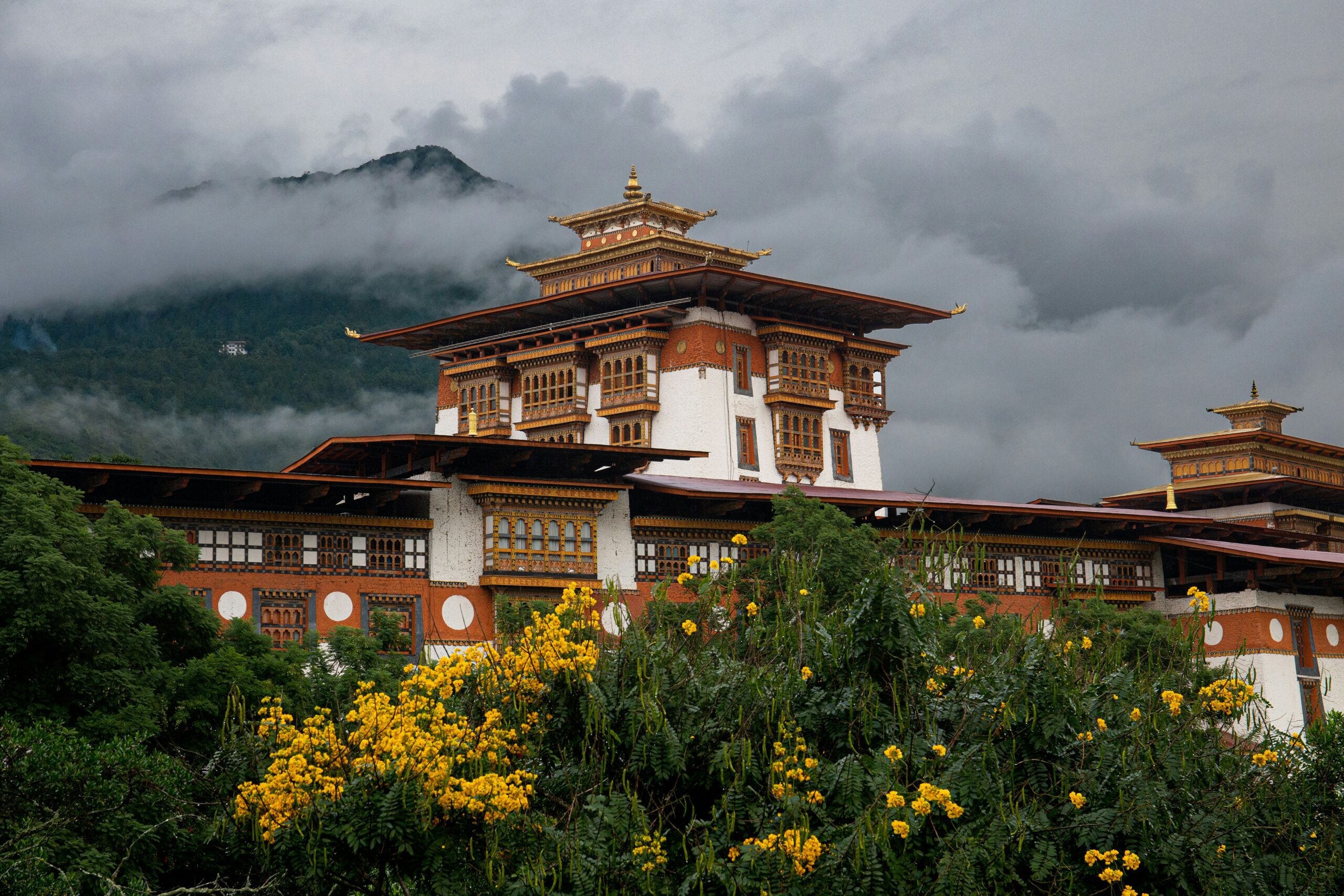
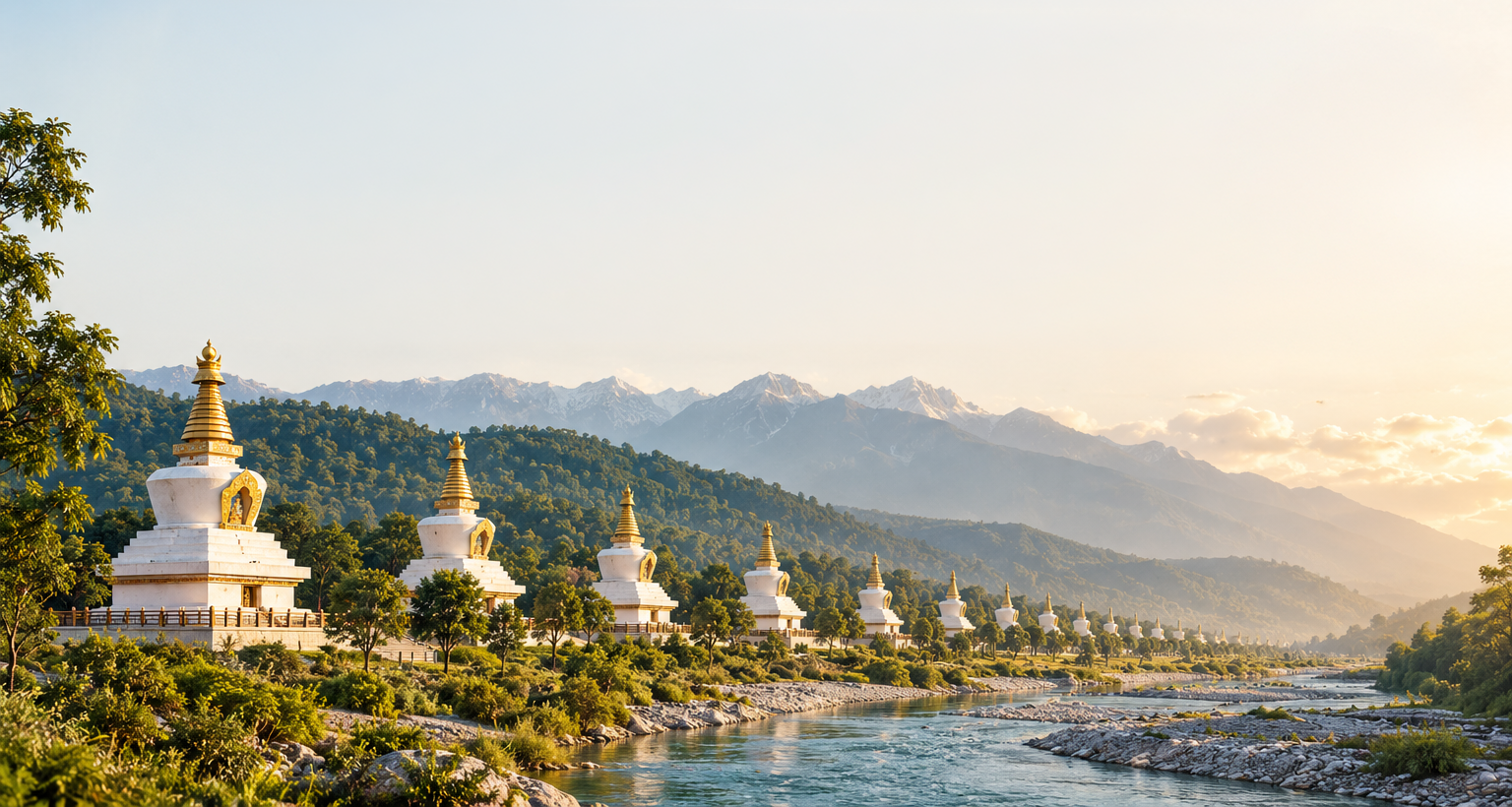
In Bhutan, 108 sacred monuments, thousands of volunteers, and one day have brought together architecture, spirituality, and collective purpose in Gelephu Mindfulness City.
On November 1, 2026, an undertaking unfolded along the Mau Chhu River in southern Bhutan. Across nearly 12 kilometres, the external structures of 108 sacred Buddhist monuments were erected in a single coordinated day.
Known as Project 108, this ambitious initiative brought together thousands of people in a collective offering of peace, compassion, and unity. Beyond its architectural ambition, the project draws on centuries of Buddhist tradition, months of preparation, and a remarkable mobilisation of volunteers.
And at the heart of it all is a larger vision: Gelephu Mindfulness City (GMC), Bhutan’s emerging experiment in bringing their values into the very foundations of urban development:
“It draws inspiration from Bhutan’s living Vajrayana tradition while remaining open to other Buddhist and wisdom traditions that share the aspiration to cultivate compassion, clarity, and insight. The intention is not only to preserve sacred heritage but to create a living environment where timeless wisdom can find new expression in the modern world.”
A Project Built on a Shared Vision
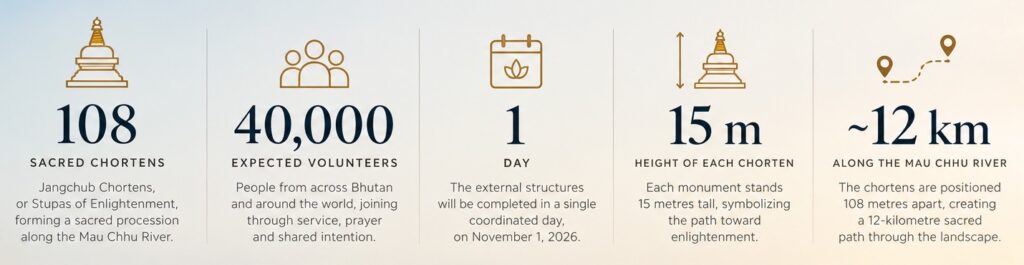
Project 108 was announced by Bhutan’s King Jigme Khesar Namgyel Wangchuck on February 21, 2026, as a royal initiative to construct 108 Jangchub Chortens, or Stupas of Enlightenment, along the Mau Chhu River.
The monuments are intended to form a continuous sacred procession through the landscape, creating a lasting expression of Bhutan’s spiritual heritage.
The ambition was exceptional: to complete the external structures of all 108 chortens, each standing 15 metres tall, on November 1st, 2026, following months of work preparing their foundations and construction materials.
Since the royal announcement, the project has mobilized teams responsible for engineering, site preparation, foundations, construction materials, volunteer coordination, and religious ceremonies.
Buddhist masters and monastic communities have also been preparing sacred texts, prayers, and ritual objects to be placed within the monuments. In October, Bhutan’s Je Khenpo, the country’s chief Buddhist abbot, led ceremonies intended to bless the undertaking and remove obstacles to its completion.
November 1 was chosen for its own symbolic importance. It coincides with Lhabab Düchen, the Buddhist festival commemorating the Buddha’s descent from the heavenly realm, as well as the anniversary of the King’s coronation.
As the King expressed when announcing the project:
“We must do it to prove to ourselves that, as we face the challenges ahead, there is no limit to what we can achieve when we stand together.”
The Chorten: Architecture as a Path to Enlightenment
The monuments themselves are rich in meaning.
A chorten, the Bhutanese and Tibetan form of a Buddhist stupa, is a sacred monument that may enshrine relics, prayers, and religious texts. The Jangchub Chorten, or Stupa of Enlightenment, specifically commemorates the Buddha’s attainment of enlightenment. Its architecture translates Buddhist teachings into physical form.
From its stepped base to its rounded dome and ascending spire, each element carries symbolic significance, representing aspects of Buddhist teachings, the journey toward enlightenment, and the union of compassion and wisdom.
The meaning also extends within the structure, where sacred texts, prayers, and ritual objects are placed through traditional ceremonies. Their preparation has involved months of dedicated work by monastic communities.
In this sense, Project 108 brings together two forms of craftsmanship: the technical expertise required to construct enduring monuments and the spiritual traditions that give those structures their deeper significance.
108: A Number Rich in Meaning
Why 108 monuments?
Far from being arbitrary, the number 108 holds deep significance in both Buddhist and Hindu traditions.
In Buddhist traditions, 108 is commonly associated with the mental afflictions to be overcome on the path towards enlightenment. It is also reflected in the 108 beads of many Buddhist prayer malas, used in reciting mantras. The number holds significance in Hindu traditions too, appearing in sacred texts and devotional practices.
Although interpretations vary across traditions, the number repeatedly evokes practice, completeness, the pursuit of wisdom and the relationship between individual transformation and a greater whole.
In Project 108, this symbolism becomes part of the architecture itself: 108 chortens, positioned 108 metres apart, create a sacred procession along the Mau Chhu River.
A symbol of spiritual awakening becomes an architectural rhythm, inscribed into the landscape.
Building Together: When Service Becomes a Practice
Perhaps the distinctive dimension of Project 108 lies also in the way it is being brought into existence.
The initiative draws on zhabto, Bhutan’s tradition of voluntary communal service, in which individuals contribute their time and effort for the benefit of others. In this tradition, practical contributions to religious and community projects, from clearing land to preparing food, become expressions of service and shared responsibility.
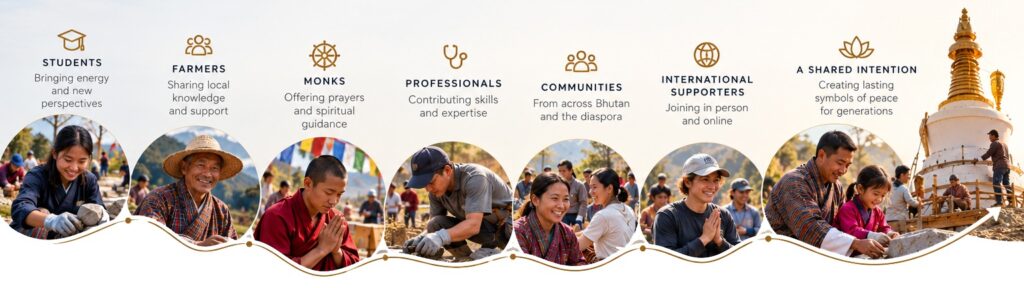
Project 108 has brought together people from different generations, professions, and backgrounds: students, farmers, doctors, retirees, monks, construction specialists, and members of the Bhutanese diaspora.
The chortens themselves were erected by trained construction teams, while the wider volunteer effort has involved preparing sites, organising transport and accommodation, providing meals, and supporting the religious ceremonies.
The response has been remarkable. By late October, more than 120,000 people had reportedly registered to attend the event, according to Bhutan Broadcasting Service. Organizers had also set a target of approximately 40,000 volunteers for the wider undertaking.
The initiative has also attracted support beyond Bhutan’s borders, including contributions from international supporters and Bhutanese communities living abroad.
Among the Buddhist figures expected to attend is Venerable Ratanaguna, Venerable Bhikkhu Paññākāra and Venerable Nun Nanika Mi who led a 108-day Walk for Peace across the United States earlier this year.
For those unable to attend in person, organizers arranged a worldwide livestream, inviting people to witness the occasion and join in prayer and spirit from wherever they are.
Through these different forms of participation, Project 108 seeks to create something greater than the sum of its individual contributions. The monuments are intended as lasting offerings, dedicated to peace, compassion, and the wellbeing of all sentient beings. The collective process of creating them also gives these values an immediate, human expression. Unity is not simply what the monuments symbolize. It is also what the project invites people to practice.
A New Expression of Gelephu Mindfulness City
Project 108 takes place within a much larger undertaking.
Announced in 2023, Gelephu Mindfulness City is Bhutan’s ambitious plan for a new urban and economic centre within a specially governed region in the south of the country. It seeks to bring together technological innovation, environmental responsibility, cultural heritage, and spiritual values.
In its earlier two-part series, The Uplift explored the architectural vision behind GMC, including its integration with the natural landscape, and the philosophical principles intended to guide its governance and development.
Since then, the project has begun moving from planning towards implementation. Flood-protection works have been completed in parts of Gelephu, a new pedestrian immigration terminal opened in October, and construction preparations continue for the future international airport.
Project 108 introduces a different but complementary dimension to this emerging city.
Rather than approaching spiritual heritage as something to preserve separately from modern development, the initiative places it visibly within the urban landscape and the process of building it.
GMC remains an ambitious long-term experiment, with many aspects of its proposed urban model still to be realized and evaluated.
Yet Project 108 offers a particularly tangible illustration of the philosophy behind it: that development can be guided not only by economic objectives and physical infrastructure, but also by a shared understanding of human flourishing.
It raises a question extending well beyond Bhutan.
What might our cities become if the values we hope to cultivate within society were also reflected in the way we design, build, and inhabit our surroundings?
In Gelephu, 108 sacred monuments are intended to stand for generations. But perhaps the project’s most meaningful legacy will not be measured only in stone, height, or distance.
It may also be found in the thousands of people who have already contributed to their creation, demonstrating how architecture can become an expression of something profoundly human: the capacity to unite around a shared purpose.
Discover the wider vision behind Gelephu Mindfulness City in The Uplift’s two-part series:
Part 1: Designing a Mindfulness City
Part 2: Spirituality, Governance, and Global Ambition