

Every May 25th, International Plastic Free Day — launched by the non-profit Free the Ocean — invites people around the world to avoid single-use plastic for one day. No disposable bottle, no plastic bag, no wrapped cutlery. A symbolic gesture, but one that points to something deeper: the growing conviction that single-use plastic is not inevitable.
This year, the context has shifted. The severity of plastic pollution has not diminished, as global production currently exceeds 380 million tons annually. Furthermore, data from OECD indicates that an inadequate 9% of this volume is actually recycled.
For the first time, systemic responses are taking shape. In 2026, reuse is moving from activist commitment to regulatory and industrial infrastructure.
Portugal, Greece, Spain: deposit systems reach Southern Europe
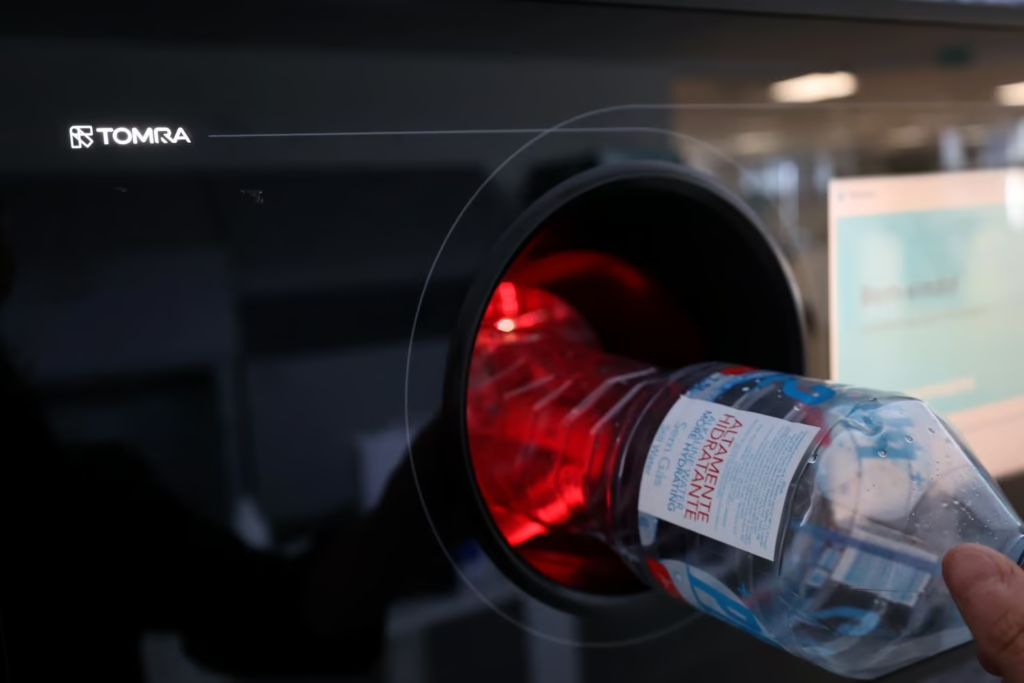
On April 10, 2026, Portugal officially launched its national deposit return scheme for plastic bottles and cans — the first large country in continental Southern Europe to do so. Customers pay €0.10 at purchase and get it back when they return the container at one of more than 2,500 automated reverse vending machines deployed across supermarkets, petrol stations and restaurants, including in the Azores and Madeira. This scheme is administered by the non-profit SDR Portugal, with digital tracking infrastructure built by Sensoneo, which has operated similar systems across several European countries.
Greece is finalizing the rollout of its own scheme this year, operated by DRS Hellas SA, a non-profit created by major beverage producers and retailers. Spain recorded only a 41% separate collection rate for plastic bottles in 2023 — well short of the EU’s 70% target — confirmed in November 2024 that it would launch a national deposit scheme within two years. A pilot in the town of Sangüesa, Navarra, already collected over 150,000 bottles since its launch in June 2025
These launches are backed by hard evidence from countries that moved earlier. According to the Reloop Platform’s December 2025 DRS Fact Sheet, Lithuania went from a collection rate below 34% before its scheme to 92% within two years of launch. Ireland jumped from 49% to 81% in its first year. Austria, which launched in January 2025, reached 81.5% by year’s end. Germany, which introduced its system in 2003, now exceeds 98%.
The PPWR: a countdown for businesses across Europe
Behind these national launches sits a broader regulatory framework which will be coming into force in less than three months. The EU Packaging and Packaging Waste Regulation — known as the PPWR (EU 2025/40) — applies across all member states from August 12, 2026. It replaces a directive dating back to 1994 and sets binding reuse targets: at least 10% of beverages must be available in reusable packaging by 2030, rising to 40% by 2040. From January 2030, all transport packaging used in intra-EU shipments between companies must be reusable.
On March 30, 2026, the European Commission provided compliance clarity with its first FAQ and implementation guide—just under five months ahead of the regulation’s effective date European Commission – Packaging and Packaging Waste Regulation.
As consistently highlighted in PPWR legal and compliance analyses, “all companies placing packaging on the EU market are affected, regardless of their size, sector or distribution channel” This broad scope means that the most exposed sectors—e-commerce, retail, foodservice and delivery—have no more room to wait, as packaging redesign and compliance alignment must now be initiated immediately.
Shared infrastructure, not isolated gestures
Deposit schemes and regulation alone are not enough. What is genuinely changing in 2026 is the recognition that reuse requires shared infrastructure to become economically viable.

In March 2026, the U.S. Plastics Pact published the findings of its scoping phase for the Reuse in Retail Initiative, conducted with companies including Unilever, Kraft Heinz, Henkel and L’Occitane. The report’s central conclusion: “Isolated efforts won’t build the type of system consumers actually need.” The initiative will now move into designing a shared reverse logistics system — pooled washing, repackaging and redistribution across brands — with a first in-store launch planned for 2028 in Portland, Maine, focused on prepared foods.
Measured results in Europe confirm the model works when systems are well designed. According to the European Reuse Barometer 2025 — which surveyed 115 reuse solutions across the continent — 88% of companies in the sector describe the market as “emerging or growing.” In e-commerce and hospitality, return rates already exceed 95% where operational systems are in place
Beyond the symbol of the day
International Plastic Free Day has a well-known limitation: one day without plastic does not change the systems that produce it. Free the Ocean acknowledges as much — the day’s goal is as much to help people “understand just how much plastic we actually use day-to-day” as to drive structural change.
That is precisely where 2026 marks a difference. For the first time, the response to plastic pollution is no longer resting solely on individual awareness or on the promise of recycling. It is organized around a more systemic transformation: countries launching deposit schemes, a sweeping European regulation entering into force, coalitions of brands building shared logistics, cities piloting reuse at scale.