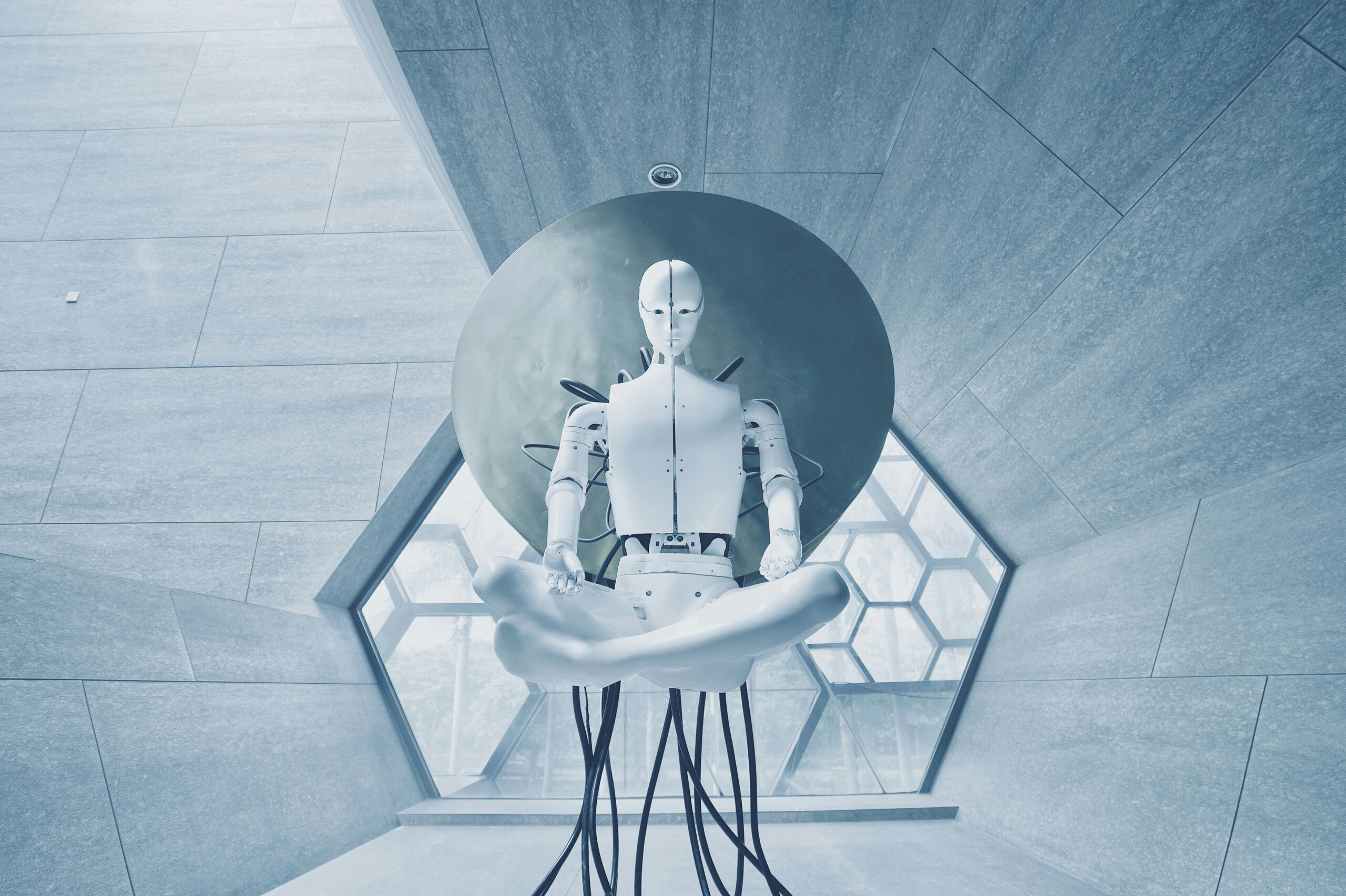
Tomorrow evening, at the National Gallery in London, an event bringing together an unusual panel of clergy and theologians, writers and academics, a former Archbishop of Canterbury, and Oxford mathematician Marcus du Sautoy, will ask one of the defining questions of our age: what does it mean to be human in the age of AI?
The event, part of the British think tank Theos’ 20th anniversary programme, will explore creativity, art, emotion and the shared human experience. The Gallery is a fitting setting. Art is one of the spheres of human activity in which AI usage has most readily flourished. It is also one of the clearest signs of human genius: our capacity not merely to produce, but to imagine, contemplate, suffer, remember, love and give meaning.
That question, of what it means to be human while coexisting with artificial intelligence, also lies at the heart of Pope Leo XIV’s first encyclical, Magnifica Humanitas – i.e., Magnificent Humanity.
AI is already helping humanity do uncountable remarkable things. It is assisting doctors in spotting tiny brain lesions that can cause severe childhood epilepsy. It is helping researchers listen more carefully to whales, birds and other animals. And, in one of the most significant cultural breakthroughs of recent years, AI has helped scholars read carbonised scrolls from Herculaneum that had been sealed since the eruption of Vesuvius in AD 79, just a few weeks ago.
These are not small achievements, showing technology at its best, placed at the service of healing, knowledge, creativity, and wonder.
Yet Pope Leo XIV’s first encyclical – i.e., a public letter sent to the rest of the world – asks the necessary question of what happens when a tool made to serve humanity begins to be served by humanity instead.
Published on 25 May of this year, the document is not a rejection of technology. It recognises that technology can “heal, connect, educate and protect our common home”. But it also insists that technology is never morally neutral; and that it carries the priorities of those who design, fund, regulate and use it.
This is not the first time humanity has struggled to make use of major technological progress wisely. Industrial food systems brought convenience and lower costs, but only later did societies begin to reckon seriously with obesity and the health consequences of ultra-processed foods. Smartphones and social media were placed in the hands of children before families or schools had fully understood their effects on attention, anxiety, childhood and friendship.
AI may be the latest and most powerful version of the same mistake. Its potential is immense, but its effects are still uncertain. It may deeply transform medicine, education, science, art and communication. It may also distort truth, deepen loneliness, automate surveillance, concentrate power, weaken human judgement and place ever more decisions beyond ordinary moral scrutiny. Pope Leo therefore emphasises that we need to ensure that we have the discernment to use it well.
That concern is widely shared. London hosted two weeks ago a Responsible AI Conference on regulation, ethics and sustainability. In Montréal, a public declaration on responsible AI last year has called for its development to serve the well-being of all people. The encyclical is therefore giving depth to questions that people across the world are already asking. And it is bringing ancient Christian wisdom to bear onto this startlingly modern issue.
In addition to the widespread concerns that AI may take jobs or concentrate power in a few companies, the Pope’s deeper, spiritual concern, in his letter, is that human beings may come to see themselves as mere data, as performance and productivity-driven, and as upgradeable machinery.
Unfortunately, that concern is well founded. The ambient ideology of transhumanism – which advocates for mind-uploading, escaping the real world for a false digital paradise, and technological human ‘upgrading’ – is increasingly present, and is promoted by some of the richest and most powerful people on Earth. In Silicon Valley and beyond, some have even spoken openly of AI in religious terms. Anthony Levandowski, an engineer for Google, co-founded and finances the religious organisation “Way of the Future” which promotes the “worship of a Godhead based on Artificial Intelligence”.
Magnifica Humanitas addresses these concerns. It counters a mechanistic, soulless vision of humanity with a richer view of the human person. In contrast to the idea of an ‘enhanced’ humanity, Leo affirms the goodness of incarnation. For centuries, Christians have believed that the human body and matter were good enough for God to incarnate himself, and therefore must be good enough for humans too. They have drawn the conclusion from this that the material world – the place where love, conscience, compassion, and communion become real – should not be avoided, even in the face of promises of a technological paradise, but rather embraced and used to experience the fullness of God’s love for them.
Strikingly, the encyclical has been welcomed widely beyond Roman Catholic circles. Secular newspapers and technology commentators across the world have treated it as a serious contribution to AI ethics – revealing, perhaps, that beneath our fascination with innovation lies a deeper hunger for wisdom. And that more than asking simply what AI can do, modern civilisation wants to ponder what kind of people we wish to become.
The good news is that we don’t need to bin ChatGPT just yet. AI can still be ordered towards learning and human flourishing – as long as we develop the wisdom to use these tools with discernment, and make sure AI remains the servant of humanity, and not the other way round.



One thought on “Pope Leo XIV’s Wise Warning for the Age of AI”
Comments are closed.