Many journeys involve crossing boundaries. Increasingly, technology is also helping travellers cross other kinds of boundaries: those that can exist between people, languages and ways of experiencing the world.
On September 27, World Tourism Day 2026 will explore these developments under the theme “Digital Agenda and Artificial Intelligence to Redesign Tourism.” The United Nations has placed accessibility at the center of that conversation, seeking to make digital advances beneficial to a wider range of travellers and communities. This is reflected in its call for a digital future for tourism that is open and human.
As artificial intelligence (AI) becomes part of travel planning, hospitality and destination management, research and tourism initiatives are indeed beginning to reveal its potential to help more people access, understand and participate in travel.
Making Tourism More Accessible
For millions of people, travelling still involves barriers that extend well beyond reaching a destination. According to the World Health Organization, around 1.3 billion people (approximately 16% of the global population, or one person in six) experience significant disability.
A review published in Information Technology & Tourism in 2026 examined 66 peer-reviewed journal articles on AI and accessibility in cultural and heritage tourism published between 2022 and 2026. The findings highlighted several potential applications, including adaptive interaction, personalized guidance and multimodal communication designed to respond to different physical, sensory and cognitive needs.
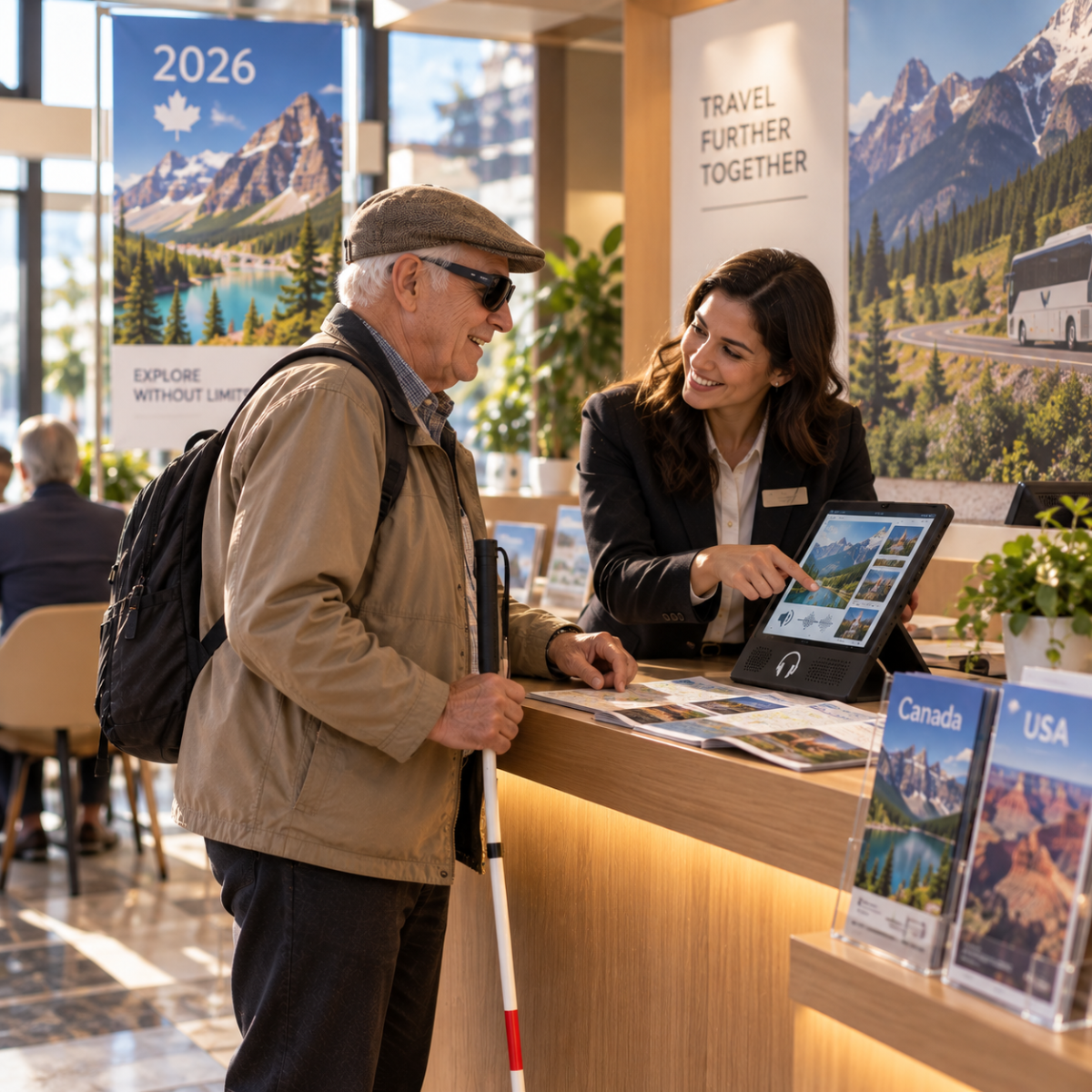
For a traveller with a visual impairment, AI-assisted technology (whether integrated into a museum or heritage site or accessed through a personal device such as a smartphone) could provide contextual descriptions of an artwork or historic site. For someone with mobility limitations, digital navigation tools could help identify an accessible route. Information can also be delivered through different formats, including visual, audio and other multimodal interfaces, according to a visitor’s sensory or communication needs.
Breaking Down Language Barriers
The ability to participate in tourism also depends on something more universal: understanding and being understood.
For international travellers, language differences can affect almost every stage of a journey: understanding information at an attraction, communicating with hotel staff, navigating a destination or discovering the meaning behind a cultural experience. AI is increasingly being applied to these situations.
In Brussels, visit.brussels is developing an AI-assisted translation system for museums across the Brussels-Capital Region. This Project is designed to provide real-time written and audio translation in all 24 official languages of the European Union, alongside additional languages spoken by local communities. Visitors will be able to access the service on their own devices without downloading an application.
This project was developed through a co-creation process with Brussels museums and a survey of 20 cultural institutions, which identified language barriers, accessibility challenges and the need for digital tools adapted to visitors’ needs. The first museums are expected to introduce the system in early 2027, followed by a gradual rollout.
Beyond translating museum content, language technology is also entering everyday encounters between visitors and the people who welcome them.
A study published in the International Journal of Tourism Research in April 2026 examined the use of machine translation in high-end hotels in Lisbon and Barcelona. Based on 37 interviews with international experts, hotel directors and front-office employees, the researchers found that machine translation can facilitate understanding when language barriers arise, while concluding that it remains a complement to, rather than a replacement for, human language skills.
From Crossing Borders to Understanding Each Other
Tourism has always involved more than movement between places. It brings people into contact with languages, histories, cultures and ways of life different from their own.
AI does not eliminate the barriers that can accompany those encounters. A translated sentence cannot by itself create cultural understanding. Technology cannot reproduce curiosity, empathy or the human connection that can emerge between a visitor and a host, but the developments now taking place reveal something more tangible.
A traveller who cannot see a monument may gain another way to experience it. A person with reduced mobility may receive information that makes navigating a destination easier. A visitor standing in a museum thousands of kilometres from home may be able to understand its stories in their own language. A hotel employee and a guest who do not share a language may nevertheless find a way to communicate. None of these advances remove the need for human presence. Instead, they can expand the conditions in which human encounters become possible.
That gives the theme of World Tourism Day 2026 a significance that extends beyond technological innovation. Tourism has long connected people by enabling them to cross geographical borders. Emerging technologies are beginning to help some travellers cross barriers of language, information and accessibility as well.
Progress remains uneven, and the research makes it clear that unifying technology requires thoughtful design, representative data and human oversight. These considerations echo a broader conversation surrounding AI, as researchers, governments and technology companies increasingly examine how AI can be developed safely and responsibly. The benefits already emerging in tourism offer one example of what such progress can look like: technology focused not simply on advancing capabilities, but on responding to human needs.
In that sense, the evolution of tourism technology reflects a broader human aspiration. Its value may lie not simply in helping us travel farther, but in helping more people participate in the journey across physical, linguistic and cultural barriers. By making places more accessible and communication easier, these tools can create new opportunities for connection between people who might otherwise struggle to meet, understand or experience one another’s worlds. As AI continues to evolve, tourism offers a tangible reminder that technological progress can also be measured by its capacity to bring people closer together safely and with humanity at its centre.