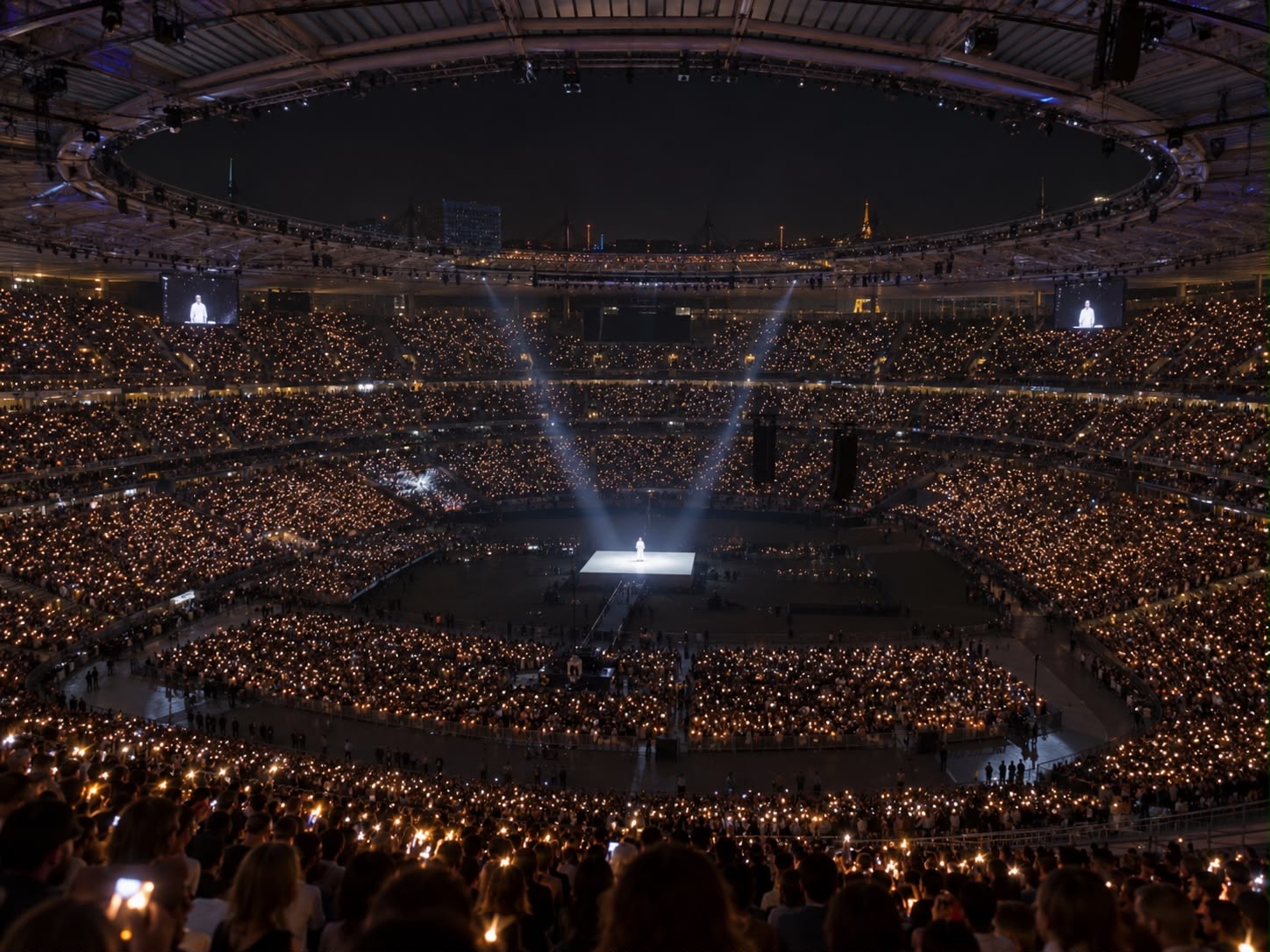
On Friday evening, 80,000 young people filled the Stade de France. They had come from across France – students and workers, from cities and rural communities – not for a football match or concert, but for a prayer vigil with Pope Leo XIV. The stadium was full. The following afternoon, around 800,000 people, according to Vatican estimates, gathered for an open-air Mass at the Place de la Concorde and along more than two kilometres of the Champs-Élysées.
Large papal crowds in Paris are not unprecedented. More than a million people attended John Paul II’s World Youth Day Mass at Longchamp in 1997, while around 260,000 gathered for Benedict XVI in 2008. Yet Leo’s visit comes in a different, supposedly highly secularised France, and the sight of tens of thousands of young people praying together, followed by hundreds of thousands filling central Paris for Mass, has generated much thought and raised many questions in mainstream French media.
Leo’s four-day journey, from 25 to 28 September, took him from Paris and Saint-Denis to Lourdes and finally Metz.
Indeed, why does the visit of a religious leader still attract such attention in a proudly secular republic?
As The Uplift previously explored, overall declining religious affiliation does not necessarily mean declining spiritual curiosity. France has itself seen a sharp rise in adult baptisms in recent years. And the crowds this weekend were not composed solely of practising Catholics: there were many curious onlookers near the Mass, and quite a few young atheists and members of other religions alongside Catholic participants at the youth vigil at the Stade de France.
The scale of the response was only part of the story. Reports of the events on Friday and Saturday repeatedly reach for the language of joy and calm. Le Parisien described a “gentle fervour” among the 300,000 people lining Friday’s papamobile route, while young people sang hymns as they walked through Saint-Denis towards the stadium. On France 5’s C à vous, historian of religions Jean-François Colosimo called the Pope’s two-day Paris leg “a suspended moment” and “36 hours of goodwill” in a France he described as “worn and divided”. For many of those present, the visit appears to have been experienced as a rare moment of public peace, openness and unity in a fractured society yearning precisely for those things.
Indeed, some saw something wider in the gathering. Former French prime minister Gabriel Attal, who was one of a number of political figures in attendance at the Mass, described the scenes as revealing a need for “communion and gathering” in France. Corsican Cardinal François Bustillo had expressed a similar thought before Leo’s arrival on France 2’s Quelle Époque!, where he pointed to people travelling across the world in search of spirituality, while growing numbers of young French adults are approaching the Church themselves. “We are navigating between the absence of God and the thirst for God,” he said.
Leo then took up almost the same theme in his sermon. Human beings, he told the crowds, carry a thirst for “meaning, for truth and fulfilment”, one that material possessions and immediate satisfactions cannot entirely answer. The question he posed – what are we really seeking? – reaches well beyond those who share his faith.
Yet to understand the visit only as evidence of a spiritual search would miss another part of it.
Although the Vatican deliberately framed Leo’s four days in France as an ‘apostolic journey’, focussed on prayer and pastoral visits rather than a state visit, the Pope’s time in France has been far from apolitical. At the Élysée, before President Emmanuel Macron and representatives of French public life, Leo offered a deliberately Christian reading of France’s history. He argued that the country’s “spiritual, cultural, intellectual, artistic and missionary” genius had drawn deeply on Christianity, and connected that inheritance to French humanism, human dignity and even the ideals expressed in liberté, égalité, fraternité.
He also commented on the proper meaning of laïcité – secularism – and argued that a “just” secularism should not mean pushing religion out of public life, but allowing the state and religious institutions to remain distinct while working together for the common good. A Christian who brings convictions formed by faith into public life, he argued, should not for that reason be regarded as a threat to national unity.
Perhaps even more strikingly from a political perspective, Leo criticised genetic manipulation, surrogacy and the trade in human organs in the same speech, and warned against the possibility of “arranging one’s own death” in reference to France’s recently adopted assisted dying law. He also spoke out against nuclear rearmament and called for more ethical reflection on artificial intelligence, a topic also covered in his first encyclical, Magnifica Humanitas. Many French citizens will disagree with the Pope on these contested political and ethical issues. Nevertheless, they demonstrate that millenary faith traditions can contribute even to contemporary political debates by providing a moral framework through which political choices can be questioned.
The Pope’s journey to France ended today on an explicitly interfaith note. In Metz, leaders of France’s Catholic, Protestant, Orthodox, Jewish, Muslim and Buddhist communities signed the Appel de Metz in Leo’s presence, committing themselves to continued dialogue, greater mutual understanding and standing together for justice and peace.
It remains true that the number of practising Catholics is declining in France and elsewhere in the Western world. The enormous crowds on Saturday do not settle the larger question of the future of religion in Europe. However, Pope Leo’s visit to the French capital cannot be dismissed as an anomaly in an otherwise secular age.
Although decades of secularisation have changed the way people relate to religious institutions, they have plainly not extinguished, among many people, the desire for transcendence, community or moral meaning. In Paris this weekend, this desire manifested itself in many different ways: young people praying and singing in a stadium; hundreds of thousands gathering around an altar at the Place de la Concorde; curious onlookers joining believers; people of different faiths and none sharing the same crowds; and a religious leader addressing political power in explicitly moral terms.
Whatever else may be said, the sacred, it seems, has not disappeared from that most secular of cities.