

On August 6th, 2026, an American Airlines flight takes off from Corpus Christi, Texas, bound for Dallas. At first glance, it looks just like any other flight. Yet this flight marks a milestone in the history of sustainable aviation fuels (e-SAF): part of the fuel used was produced from captured CO₂ and renewable electricity.
On this occasion, Corpus Christi Airport also became the first U.S. commercial airport to receive this synthetic fuel. The aircraft itself did not require any modifications to use it.
This event remains modest in the context of global air travel. However, it illustrates an interesting possibility: what if some of the carbon emitted by our industries could become a resource for producing jet fuel?
An Increasingly Busy Sky, a Growing Climate Challenge
Thousands of airplanes crisscross the sky every day, connecting continents and bringing people closer together. This mobility contributes to economic exchange, tourism, and international relations. However, as air travel continues to grow, so does its environmental impact.

According to a report by the International Council on Clean Transportation (ICCT) in October 2026, global passenger traffic increased by 42% between 2013 and 2023, while associated greenhouse gas emissions rose by 21%. Improvements in aircraft efficiency have thus helped slow the rise in emissions, though they have not yet reversed the trend.
The impact is not limited to CO₂. Airplanes also emit nitrogen oxides, water vapor, and particulate matter. Under certain atmospheric conditions, their contrails can develop into high-altitude clouds that contribute to global warming.
Research by David S. Lee and his colleagues, published in Atmospheric Environment in 2021, showed that these non-CO₂ effects account for a major portion of aviation’s climate impact. In 2018, non-CO₂ effects accounted for approximately 66% of the net effective radiative forcing attributed to aviation in their assessment.
Reducing aviation’s carbon footprint therefore requires action on several fronts: improving aircraft efficiency, optimizing operations, advancing engine technology, and developing fuels with lower emissions throughout their entire life cycle.
It is in this context that sustainable aviation fuels (SAF) are becoming increasingly important.
When Industrial Carbon Becomes an Energy Resource
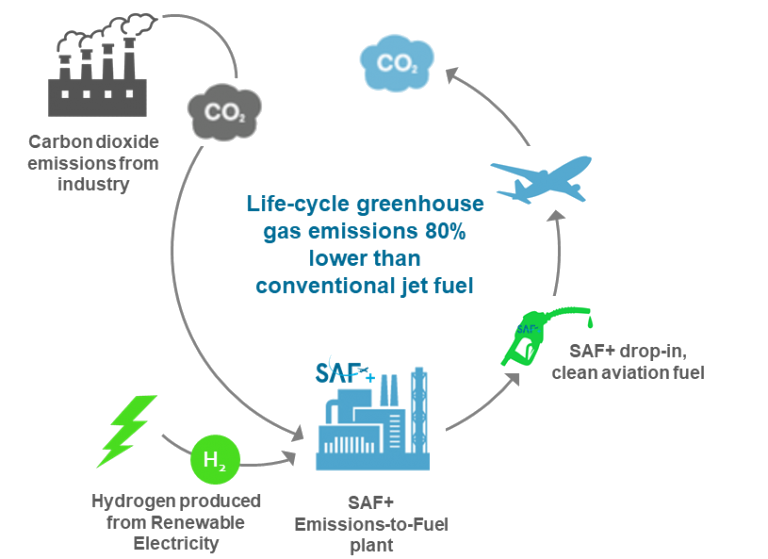
The synthetic fuel used on the August 6 American Airlines flight was produced using a technology known as Power-to-Liquid, or PtL.
The principle behind it involves a combination of processes: capturing CO₂, producing renewable hydrogen, and combining them to manufacture synthetic hydrocarbons.
On the one hand, certain industrial facilities can capture the CO₂ they emit, which is present in their flue gases or exhaust gases. On the other hand, renewable electricity enables the production of hydrogen through water electrolysis.
These two resources then become the raw materials for a sustainable aviation supply chain
CO₂ reacts with hydrogen to form intermediate molecules, such as synthesis gas or methanol. These can then be converted into hydrocarbons through various chemical processes, including the Fischer-Tropsch synthesis or the Methanol-to-Jet process. After refining and meeting aviation specifications, the result is a synthetic aviation fuel: e-SAF.

In the United States, Infinium has reached a major milestone with the delivery of fuel to Corpus Christi Airport in August 2026.China is also emerging as a major player in this new sector accounting for approximately 20% of the global capacity announced for major e-SAF projects, trailing only Europe.
photo : Daniel SLIM/AFP via Getty Images
In Europe, INERATEC’s ERA ONE plant in Frankfurt exemplifies the transition to the first industrial-scale production of synthetic fuels. In France, the DEZiR project, led by Verso Energy in Normandy, and the KerEAUzen project led by ENGIE in Le Havre, are also exploring this path.
photo : @Engie
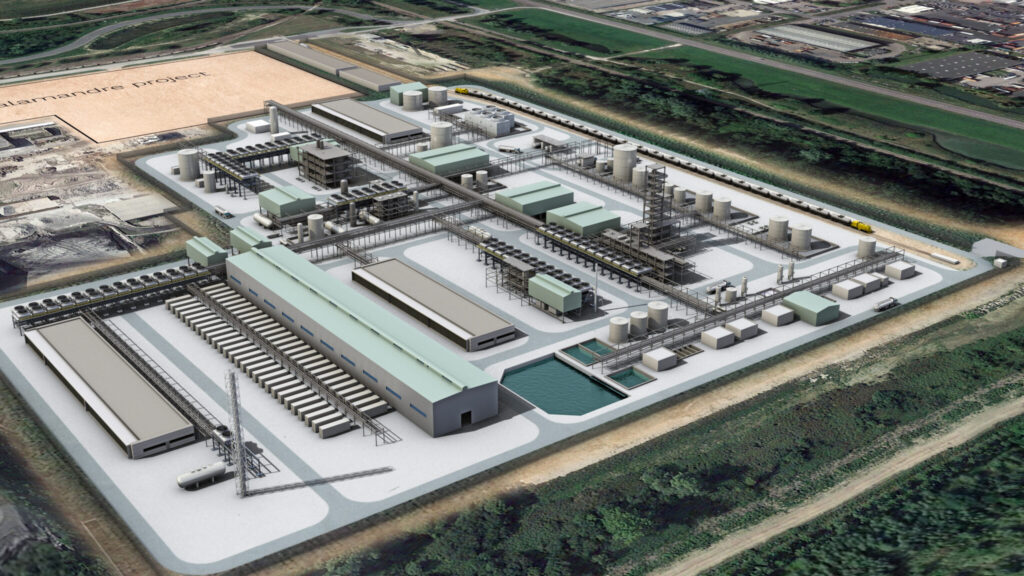
These projects are at different stages of maturity. Their growing number, however, reflects a global trend: according to T&E’s survey, 64 major e-SAF projects have been announced worldwide, 26 of which could be operational by 2030.
While the development of sustainable aviation fuels has become an international issue, not all countries are using the same approaches. Europe has chosen to create a market through regulation, while the United States places greater emphasis on incentives to boost production. In Asia, several countries are also beginning to structure their markets, including Japan, Singapore, and South Korea
These trends show that decarbonizing aviation has become a global industrial and energy issue.
An Industry That Is Reinventing Its Resources
The development of sustainable aviation fuel shows that the ecological transition does not necessarily mean giving up progress or the things that improve our quality of life. Rather, it calls for us to rethink the way we move forward. E-SAF is a prime example: turning captured carbon into a raw material, combining expertise from multiple sectors, and devising new ways to meet our energy needs.
Of course, this technology alone will not solve aviation’s carbon footprint. It still needs to mature further and become more competitive and scalable. But it reflects an encouraging trend: that of an industry no longer content to merely measure its impact, but one that is actively seeking to reduce it.
Environmental awareness is becoming a driver of innovation, and the solutions that are emerging show that progress can also be achieved through a more responsible approach to resources, energy, and living organisms.