
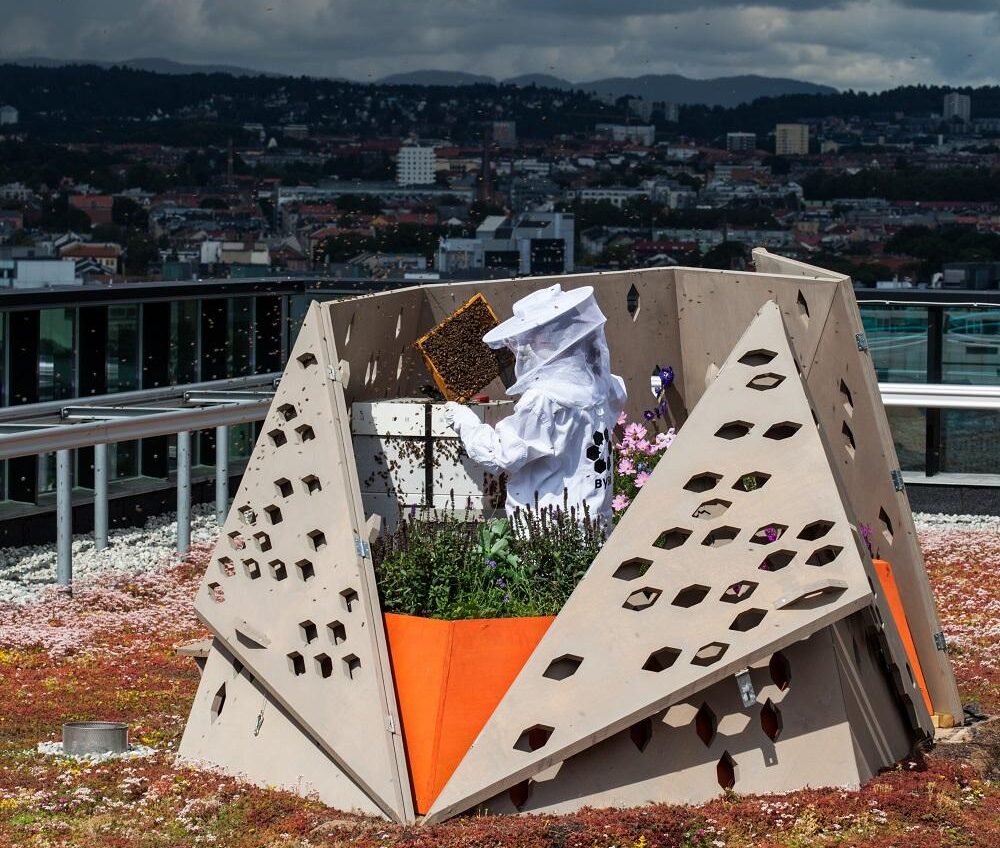
As the world marks World Bee Day 2026 on May 20, this year’s theme: “Together with Bees, for People and the Planet. A Vital Partnership for Us All” highlights the long-standing and essential relationship between humans and pollinators. Inspired by this global initiative, we set out to explore how cities around the world are embracing this theme through concrete urban biodiversity projects and pollinator-friendly initiatives.
In the spring of 2026, several major cities across North America and Europe (including Montréal, New York City, Washington, San Francisco, Athens, and Ljubljana) intensified urban biodiversity programs aimed at supporting pollinators through rooftop apiaries, community gardens, and interconnected green corridors. One of the most visible examples comes from Montréal, where the city expanded its urban beekeeping network in partnership with the Montréal-based company Alvéole, helping deploy hundreds of rooftop hives across commercial buildings and public spaces as part of the city’s broader 2021–2026 Urban Agriculture Strategy.
This movement has also gained international visibility through recent media coverage documenting the rapid rise of rooftop beekeeping in cities such as Washington D.C. and New York City, where office towers, universities, and cultural institutions are increasingly transforming rooftops into habitats for pollinators. A March 2026 report by Bloomberg noted that urban beekeeping initiatives now span more than 70 cities worldwide, reflecting a growing effort to reconnect dense urban environments with biodiversity and climate resilience.
Once considered unlikely environments for biodiversity, dense metropolitan areas are increasingly emerging as unexpected refuges for bees and other pollinators, transforming rooftops and public spaces into symbols of ecological renewal. This transformation has been accelerated by a series of municipal and civic initiatives launched or expanded during the spring of 2026, focused on increasing rooftop apiaries, strengthening pollinator corridors, and integrating biodiversity into long-term urban planning.
Cities in Motion: a Global Urban Pollinator Movement
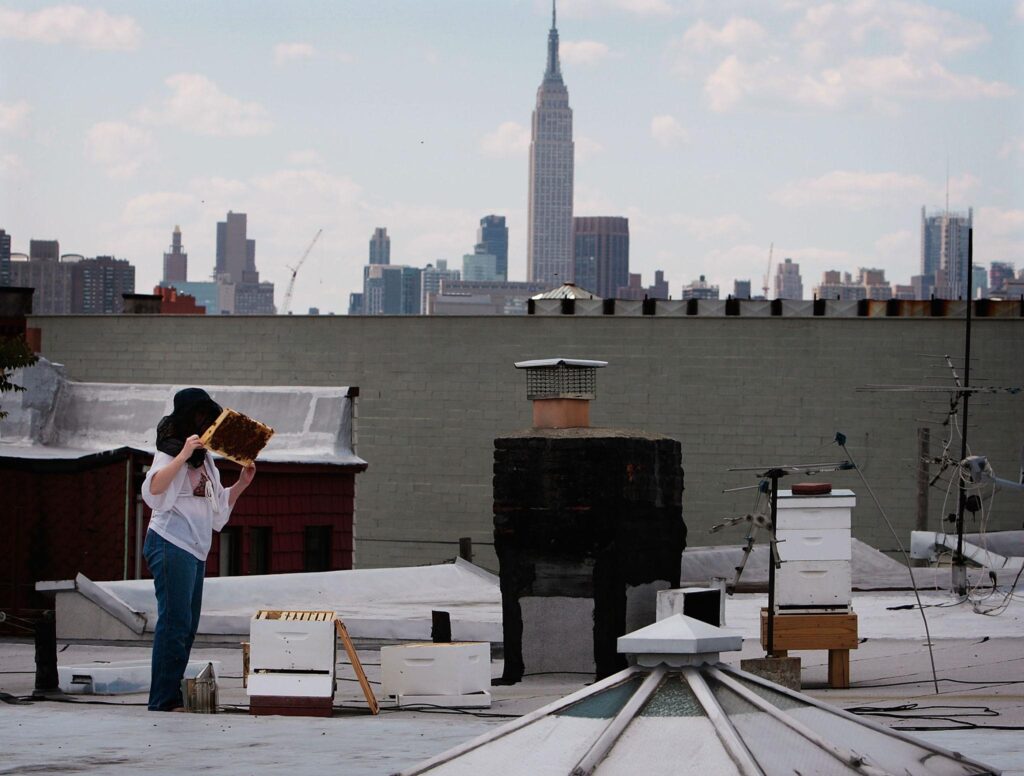
In North America, New York City has become one of the most active hubs of this movement. With more than 400 registered hives across the metropolitan area, urban beekeeping is rapidly expanding through educational and community-driven programs led by initiatives such as Bee U NYC and the New York City Beekeepers Association. These organizations are helping to build a network that connects residents, schools, and rooftops through hands-on environmental engagement.
In Europe, similar momentum is visible through the Alvéole network, which partners with buildings and institutions in cities such as Paris and Berlin to install and manage rooftop hives while integrating biodiversity education into urban environments.
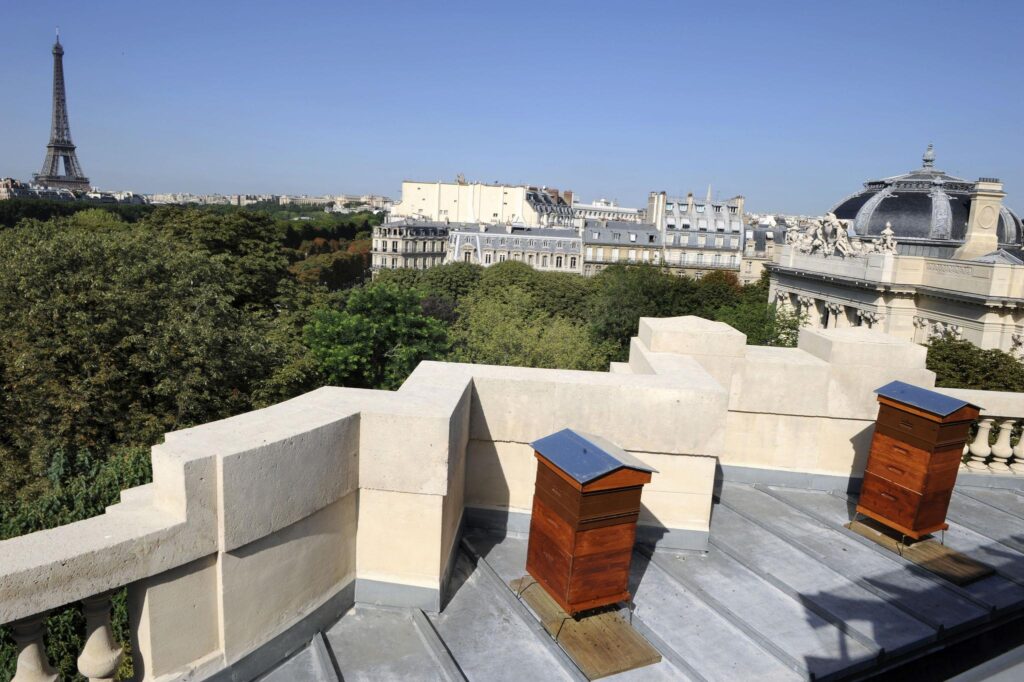
Paris offers one of the most emblematic examples of this evolution. At the Palais Garnier opera house, rooftop beehives have become a living symbol of the coexistence between cultural heritage and ecological renewal. Across the city, similar installations are now found on hotels, museums, and public institutions, reflecting a broader integration of nature into the urban landscape.
Berlin, meanwhile, is advancing a more community-rooted model. Local initiatives have transformed rooftops, schoolyards, and public gardens into micro-habitats for bees and pollinators. These projects combine ecological restoration with education and citizen participation, allowing residents to reconnect with nature directly within the urban fabric.
From Ecological Balance to Environmental Intelligence
The movement reflects a broader scientific understanding of the essential role pollinators play in sustaining life on Earth. Bees are responsible for pollinating nearly 75% of the world’s flowering plants and approximately 35% of global food crops, according to the Food and Agriculture Organization, the United Nations agency based in Rome, Italy. Without pollinators, ecosystems weaken, biodiversity declines, and food security becomes increasingly fragile.
Yet urban beekeeping alone is not sufficient. A city filled only with managed honeybee hives may unintentionally create ecological imbalance if wild bees, butterflies, and other pollinators are neglected.
Encouragingly, many new programs in 2026 appear to recognize this nuance. Among those, Municipal biodiversity plans increasingly integrate flowering corridors, pesticide reduction strategies, and habitat restoration alongside apiary development. The goal is evolving from simply “adding more bees” toward creating healthier ecosystems overall.
Another fascinating dimension of this movement lies in environmental monitoring. Bees are now being used in several countries as living bioindicators capable of helping scientists measure environmental quality. By analyzing honey, wax, and pollen collected by bees, researchers can detect traces of heavy metals, airborne pollutants, and chemical residues across urban and industrial areas.
In some regions, hives have even been installed near waste incineration facilities and industrial zones to monitor atmospheric pollution. Because bees travel across large areas and interact continuously with vegetation, they provide an extraordinary picture of environmental health. Recent scientific publications have highlighted how these pollinator networks can contribute valuable data for ecological surveillance and public health research.
Cities Reconnected: Nature, People, and Urban Regeneration
Beyond science and policy, the return of bees to cities carries something deeply human. Urban residents who once felt disconnected from natural cycles are beginning to engage directly with biodiversity. Rooftop hives, community gardens, and pollinator projects create opportunities for education, intergenerational dialogue, and shared responsibility.
Children in schools learn how pollination supports food systems. Office workers discover hives above their buildings. Citizens who may never visit a farm begin to understand the fragile interdependence between humans and ecosystems. In an age often dominated by environmental anxiety, these initiatives offer visible and practical ways of reconnecting with nature and the broader animal world, fostering a renewed sense of unity between people and the living systems that surround them.
Importantly, the urban bee movement also challenges an outdated assumption: that cities stand in opposition to nature. Increasingly, urban centers are proving they can function as laboratories for ecological innovation. Green roofs, vertical gardens, biodiversity corridors, and pollinator sanctuaries are redefining what sustainable cities may look like in the decades ahead.
The resurgence of bees in urban environments will not solve the global biodiversity crisis alone. Pollinator populations worldwide still face severe pressures from habitat loss, pesticide use, climate change, and industrial agriculture. Yet the developments emerging in cities like Paris, Berlin, and New York reveal something essential: public consciousness is shifting toward a renewed reconnection with nature and a deeper awareness of humanity’s dependence on living ecosystems.
These projects demonstrate that environmental action is no longer confined to governments, scientists, or rural conservation areas. Citizens, architects, schools, municipalities, and local communities are increasingly participating in the restoration of living ecosystems, reflecting a broader cultural shift toward reconnection with nature and a growing sense of unity between human societies and the natural world.
And perhaps this is the most uplifting lesson of all. Every rooftop hive, every pollinator garden, and every flowering balcony represents more than a local initiative. They are part of a wider transformation. Together, they reflect an evolving relationship between humanity and the natural world, one grounded not in domination, but in coexistence, stewardship, and renewal and ultimately, unity.
In the soft hum of bees above the city skyline, a simple truth quietly re-emerges: even the smallest forms of life can help guide humanity toward a more balanced and connected future.




One thought on “The Urban Bee Revival: How Cities are Becoming Unexpected Sanctuaries for Pollinators ”
Comments are closed.