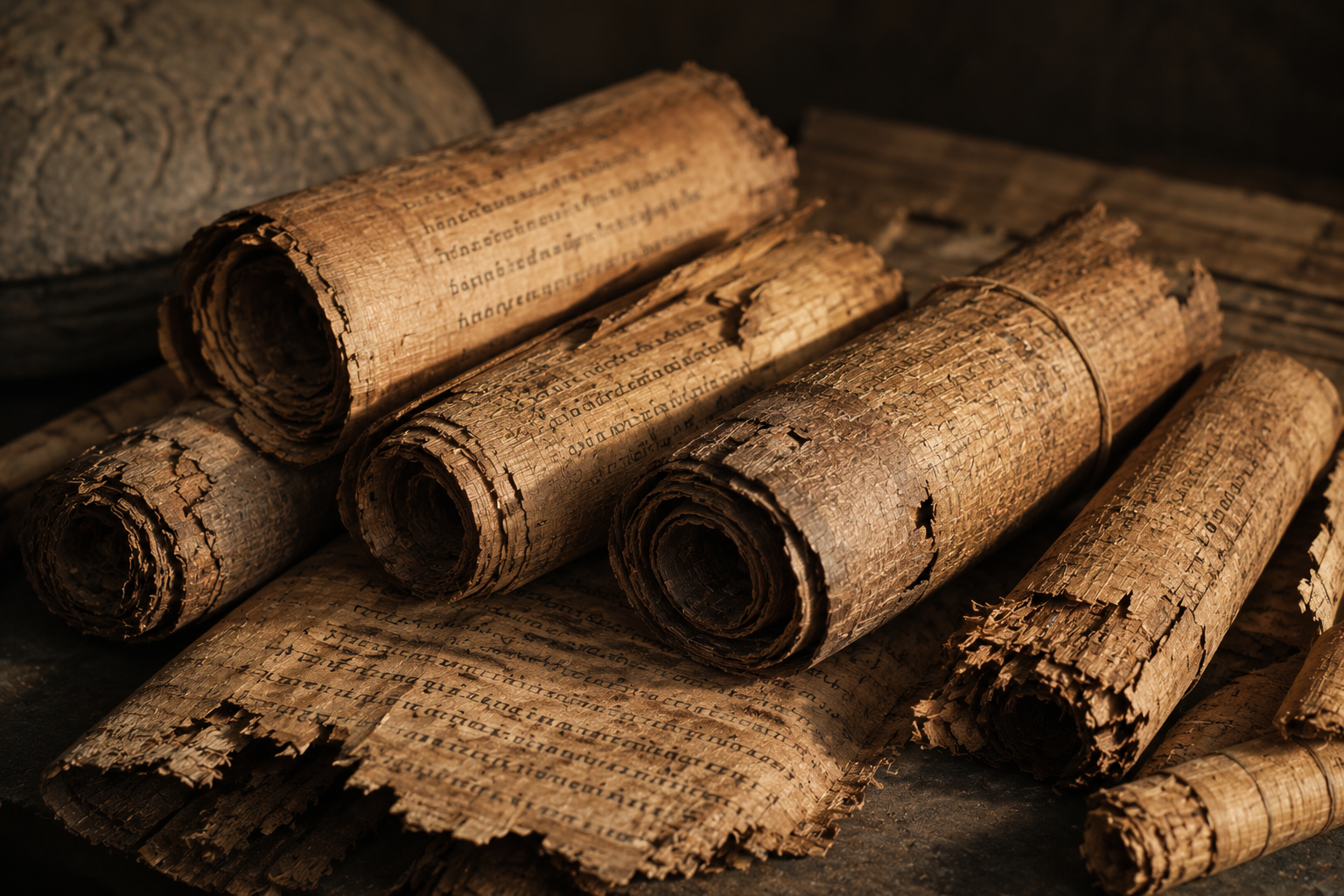
For almost two thousand years, the Herculaneum scrolls, containing poetry and prose lost to time, seemed to offer one of history’s most tantalising silences. Preserved when Mount Vesuvius destroyed Herculaneum in 79 AD, they survived as blackened rolls of carbonised papyrus: intact enough to keep their words, but so fragile that opening them could destroy them. Neither completely gone, nor accessible or readable.
Two weeks ago, that silence broke. On June 25th, the Vesuvius Challenge announced that researchers had virtually unwrapped and read the preserved text of a single scroll, PHerc. 1667, from the ancient Villa of the Papyri, without physically opening it. It is the first Herculaneum papyrus to be digitally unrolled and read end to end for sustained scholarly study.
The achievement is both a technological triumph and an act of careful cultural recovery. Using high-resolution X-ray micro-CT scans, advanced geometry, AI-based techniques, and combining tools previously not available with a cross-disciplinary approach, the team reconstructed the hidden layers of the scroll, flattened them into a readable surface, and helped papyrologists identify the faint traces of ink. The result is nearly 1.5 metres of Greek text, arranged in around twenty columns, from what appears to be a Stoic philosophical work on ethics, human nature and reason.
The words themselves are fragmentary, but they can now be read. The scroll appears to belong to the Hellenistic world of the second, or possibly late third, century BC, and it mentions Aristocreon, the nephew and disciple of the great Stoic philosopher Chrysippus. For scholars, even such clues can reopen whole rooms of thought previously known only through later quotations and summaries.
This progress has come through an unusually collaborative model of discovery. The Vesuvius Challenge was launched in 2023 by computer scientist Brent Seales, together with Nat Friedman and Daniel Gross, as an open competition to read the Herculaneum papyri. Since then, engineers, classicists, papyrologists, imaging specialists, students and independent contestants have worked across borders and disciplines. The unrolling of scroll PHerc. 1667 was enabled by collaborators from the United States, Britain, Italy, France and Germany working together. These scans relied on major facilities including the European Synchrotron Radiation Facility in Grenoble and Diamond Light Source in Oxfordshire. This collaborative approach probably sped up things considerably. Even with the current technology, a single team in a single laboratory would have spent many more years on it.
The scrolls belong to the shared inheritance of humanity, and their recovery is being treated as an international project accordingly. This project has released data and code , inviting others to test, improve and extend the work. It is a heartening example of technology placed at the service of memory, scholarship and the common good.
PHerc. 1667 may be only the first of many. Scholars have also identified Philodemus’ On Gods, Book 8 in another scroll, and made further progress on On Vices, Book 1 from a Bodleian Library scroll. More than 600 Herculaneum scrolls remain unopened. Some may contain familiar philosophical works. Others may preserve books thought lost forever.
For now, only one fragile scroll has crossed the previously unbridgeable distance from the darkness of the volcano to human eyes. If we are patient, humble and willing to continue to share our skills, there is every reason to hope that the ancient library has much more to reveal to the world.