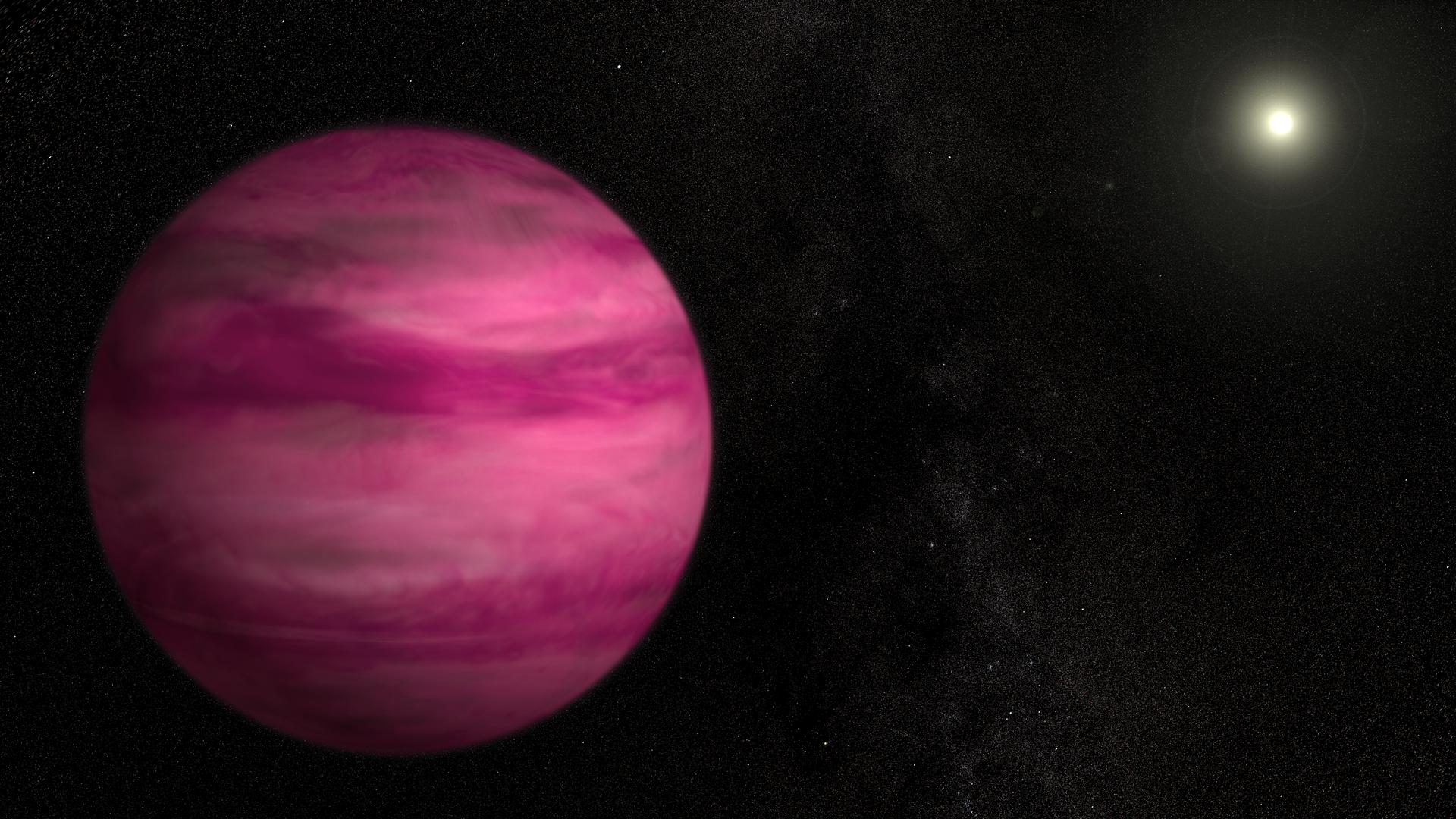
Artist’s impression of the exoplanet GJ 504b orbiting around its star. Credit: NASA/Goddard/S. Wiessinger
Among all the questions explored by science, the possibility of extraterrestrial life has long fascinated people across cultures and generations. Are we alone in the Universe? What are the secrets that make a planet like Earth habitable? Is our planet the result of a rare cosmic coincidence, or could similar conditions exist elsewhere in the Universe? The study of exoplanets — planets orbiting stars other than our Sun — could help answer some of these fundamental questions, and recent findings suggest that this may happen sooner than we think.
About ten days ago, an international team of astronomers reported some of the strongest evidence yet for magnetic fields on exoplanets — magnetic fields are often associated with habitability as they help protect planetary atmospheres from stellar winds and radiation. This result was not obtained through direct observation of magnetic fields, but rather by measuring atmospheric winds on seven Jupiter-like exoplanets. The hottest planets were found to exhibit slower winds than expected, contrary to what atmospheric models would normally predict. From this observation, the researchers concluded that the most plausible explanation was the presence of a magnetosphere, whose approximate strength could also be estimated.
“This breakthrough opens a completely new window on exoplanet research. It’s the first time we can compare the magnetic environments of other worlds—a key step toward ultimately understanding which planets can stay alive, keep their water, and perhaps even, one day, host life as we know it,” says Julia Seidel, lead author of the study. And rightly so. What makes this discovery truly exciting is not so much that exoplanets possess magnetospheres — as astronomers have long suspected — but our ability to detect them across vast distances, something that seemed unimaginable just a few decades ago.
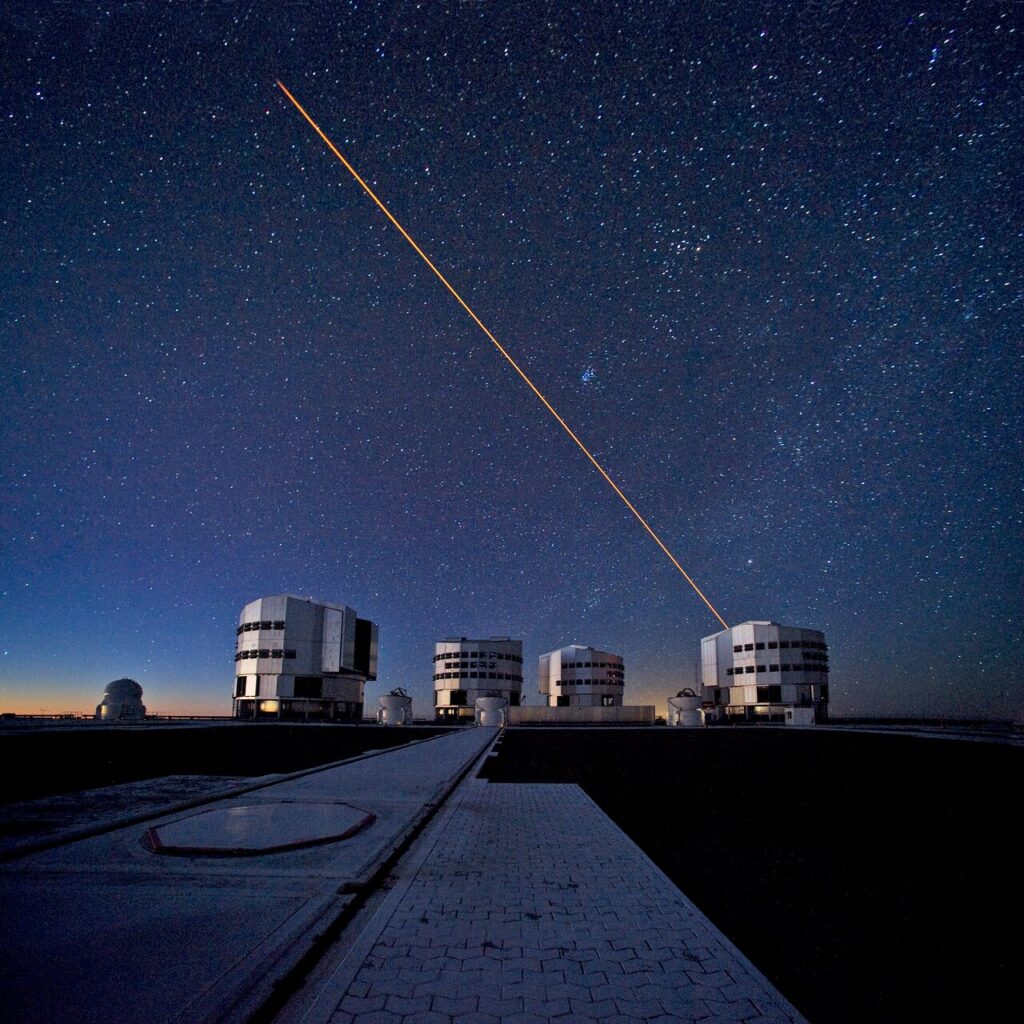
This discovery was made possible thanks to observations from the Very Large Telescope (VLT) in Chile’s Atacama Desert, one of the most powerful astronomical instruments currently in operation. In late April, another instrument, NASA’s Transiting Exoplanet Survey Satellite (TESS), also made headlines after helping identify more than 10,000 additional exoplanet candidates, further expanding the catalogue of worlds beyond our Solar System. Yet the first exoplanet orbiting a Sun-like star was discovered in 1995, just 31 years ago. Since then, our understanding of exoplanets has grown dramatically, especially in recent years.
The Very Large Telescope (VLT) in Chile’s Atacama Desert, one of the world’s most powerful astronomical observatories. Credit: ESO / S. Brunier.
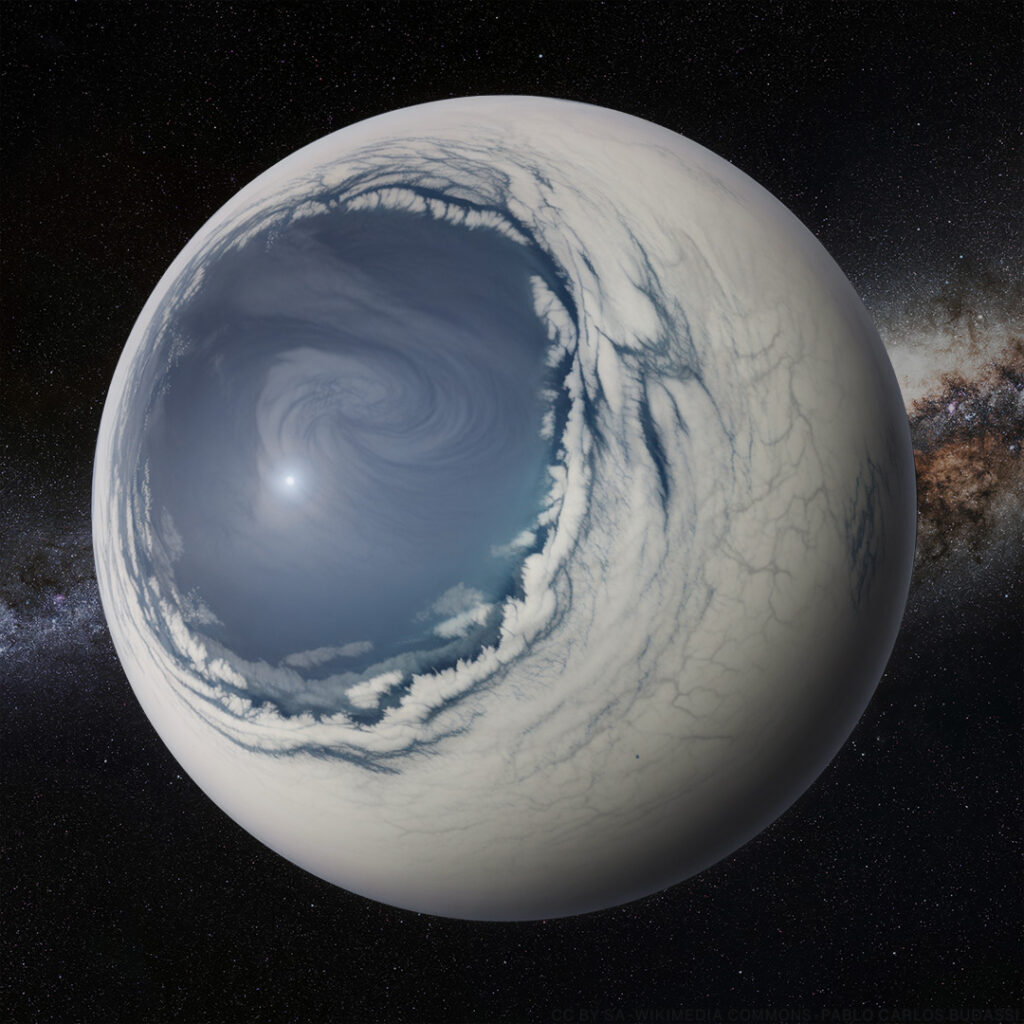
In 2024, for instance, a major milestone was reached with observations of LHS 1140 b, an exoplanet located about 48 light-years from Earth in the habitable zone of its star. Using data from the James Webb Space Telescope, researchers found evidence suggesting that the planet could be a so-called “water world”, possibly covered by a vast ocean. Because LHS 1140 b is expected to be tidally locked — always showing the same face to its star — scientists have proposed that it may resemble an “eyeball planet”: a world where liquid water exists primarily in a warm, illuminated region facing the star, surrounded by colder, frozen areas.
Illustration of a cold eyeball planet with liquid water in the region facing its star, the rest of the surface staying frozen. Credit: Pablo Carlos Budassi / Wikimedia Commons (CC BY-SA 4.0)
While further observations are needed to confirm this picture, the study already identified LHS 1140 b as one of the most promising exoplanets known to date for the search for life. Yet given the pace of new discoveries, LHS 1140 b may not hold that distinction for very long. Until recently, detecting the atmosphere of an exoplanet was considered a major achievement. Today, astronomers are beginning to estimate the strength of their magnetic fields, identify possible water worlds and detect atmospheric compounds. Perhaps someday one of these distant worlds will reveal the first clues of biological activity. Only time will tell.